
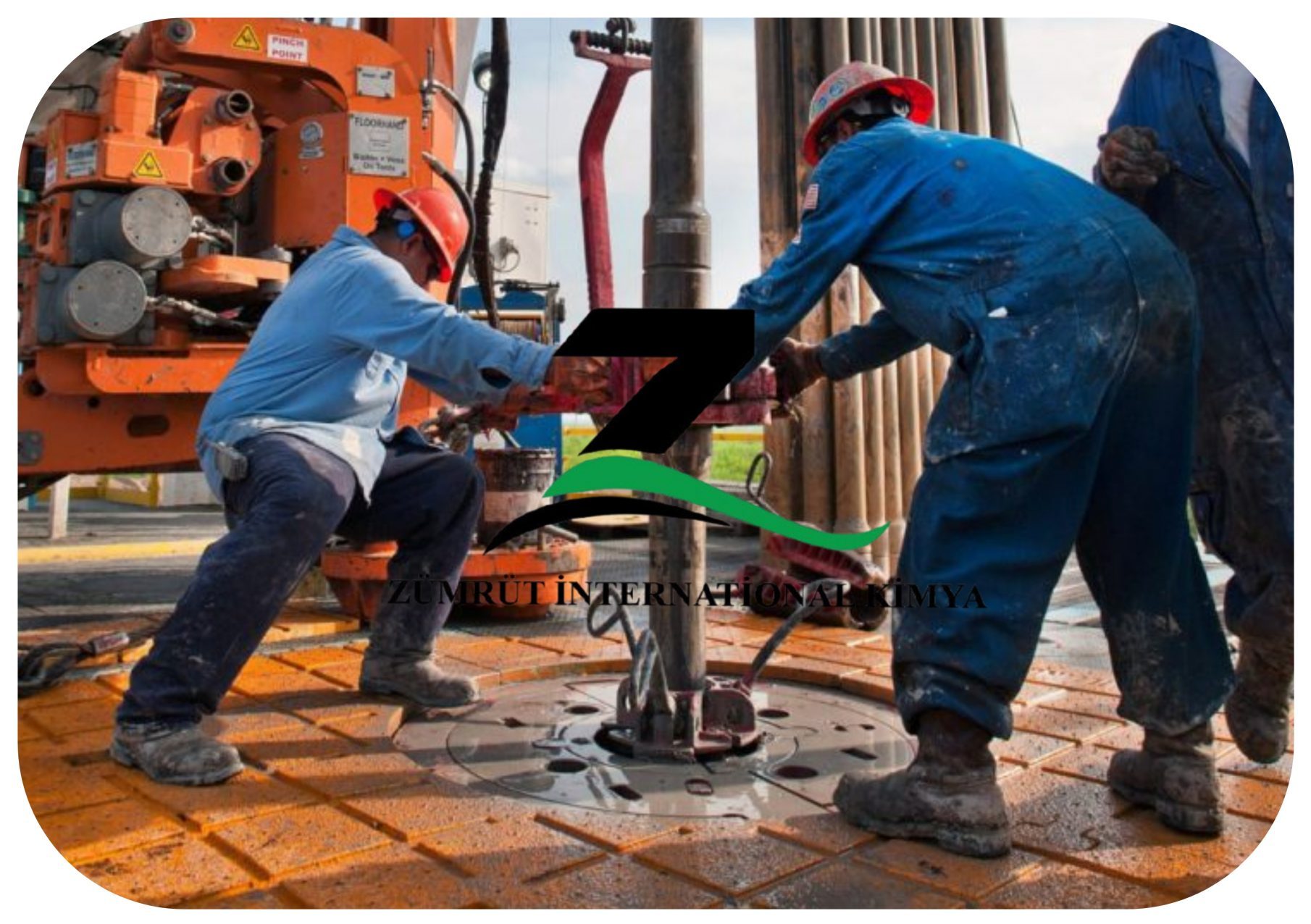
Oil-based drilling muds (OBM) are invert emulsions: brine droplets suspended in a continuous oil phase. They are the system of choice for reactive shale, high-angle wells and high-temperature sections, because the oil phase does not hydrate clay and remains stable where a water-based mud would fail. This page explains how oil-based drilling muds are formulated, what each additive class actually does, and where a high softening point fluid loss control additive fits into the system.
ZUMRUT INT Co. supplies gilsonite as a fluid loss control additive for oil-based and synthetic-based drilling fluids, with softening point and particle size specified to the mud system rather than sold as a single generic grade.
Composition of oil-based drilling muds
Every OBM is built from the same seven functional components. The oil-to-water ratio normally runs between 70:30 and 95:5, with higher oil ratios used for the most reactive formations.
| Component | Function | Typical material |
|---|---|---|
| Continuous phase | Carrier fluid; keeps clays from hydrating | Diesel, mineral oil or synthetic base |
| Internal phase | Osmotic control of shale through water activity | Calcium chloride brine |
| Primary emulsifier | Stabilises the invert emulsion | Polyaminated fatty acid |
| Wetting agent | Keeps solids oil-wet so they do not water-wet and settle | Secondary surfactant blend |
| Viscosifier | Builds gel strength for hole cleaning and suspension | Organophilic clay (amine-treated bentonite) |
| Fluid loss control additive | Reduces filtrate invasion; builds a thin, firm filter cake | Gilsonite, asphalt sulfonate, amine-treated lignite |
| Weighting agent | Provides mud density for well control | Barite, hematite, calcium carbonate |
Alkalinity is maintained with lime, which keeps the emulsifier active and neutralises acid gases. For the equivalent water-based formulation, see gilsonite in water-based drilling muds.
Why fluid loss control matters in OBM
Filtrate invasion in an oil-based system is expensive in three separate ways. It damages the producing formation by driving oil and surfactant into the pore network. It thickens the filter cake, which increases torque, drag and the risk of differential sticking. And it raises mud cost directly, because every barrel of filtrate lost downhole is a barrel of expensive base oil that has to be replaced at surface.
The number most people optimise is the wrong one. Filtration performance in oil-based drilling muds is measured by the HPHT filtration test under API 13B-2, normally at 500 psi differential and at or above expected bottom-hole temperature. But the target is not simply a low filtrate volume — it is a thin, firm, low-permeability cake. An additive that lowers filtrate while building a thick compressible cake has solved one problem and created another, and the second one is the one that sticks pipe.
How gilsonite works in an oil-based mud
Gilsonite is a naturally occurring hydrocarbon resin. In an OBM it works physically rather than chemically: particles deform at bottom-hole temperature, wedge into the pore throats and microfractures of the exposed formation, and seal them.
The property that governs this is softening point. The particle must be hard enough to survive mixing and circulation, yet soften enough at downhole temperature to deform under differential pressure. Grades with a softening point of 160 °C and above are specified for high-temperature work for exactly this reason — a low softening point grade will have already flowed before it reaches the formation face.
The second advantage is chemical compatibility. Gilsonite’s solubility in hydrocarbons, measured in trichloroethylene, carbon tetrachloride or carbon disulfide, means it disperses cleanly in the diesel or mineral oil phase instead of forming a separate water-wet solid. The same property makes it work in synthetic-based muds, where the base fluid is itself a polymer. Full figures are on the gilsonite specification page.
What it contributes to the system
- Fluid loss reduction — high softening point grades reduce HPHT filtrate substantially against untreated mud, with the gain largest at elevated bottom-hole temperature.
- Thin, firm filter cake — improves cake quality rather than simply cutting filtrate volume, which is what actually prevents sticking.
- Differential sticking prevention — a thinner cake means less contact area between pipe and wellbore wall.
- Shale stabilisation — seals the microfractures through which pressure would otherwise transmit into the formation.
- HSE profile — non-toxic, non-carcinogenic and non-mutagenic; standard PPE is sufficient for handling and disposal.
- Cost — materially lower cost per barrel treated than synthetic polymer filtration additives such as UHT-Co polymers.
Treating rates
| Application | Concentration | Grade |
|---|---|---|
| Routine fluid loss control, OBM | 5–10 lb/bbl | 100 mesh, softening point 160 °C+ |
| HPHT fluid loss control | 8–15 lb/bbl | 200–325 mesh, softening point 180 °C+ |
| Synthetic-based mud | 5–12 lb/bbl | Micronised, high softening point |
| Seepage loss and bridging | 10–20 lb/bbl | Granulated, 0.5–5 mm |
These concentrations are a starting point for pilot testing, not a substitute for it. The correct loading depends on bottom-hole temperature, differential pressure, formation permeability and the target filtrate specification. A supplier who quotes a single treating rate without asking about the well is quoting from a brochure. Related reading: drilling fluid loss control.
Gilsonite compared with other OBM filtration additives
| Additive | Mechanism | Temperature limit | Notes |
|---|---|---|---|
| Gilsonite | Physical sealing; thermoplastic deformation | Set by grade softening point; 160–220 °C available | Natural material, minimal processing, favourable HSE profile |
| Asphalt sulfonate | Physical sealing plus partial dispersion | Moderate | Chemically modified; performance varies with degree of sulfonation |
| Amine-treated lignite | Colloidal filtration control | Degrades thermally at high temperature | Effective at moderate temperature; poorly suited to HPHT |
| UHT-Co synthetic polymer | Polymeric film formation | High | Strong performance, substantially higher cost per barrel |
Field case: HP/HT wells offshore Asia
An international oil company drilled multiple HP/HT wells offshore in Asia but experienced repeated delays during logging operations, because logging tools tended to stick.
| Parameter | Value |
|---|---|
| Well depth | 14,010–15,960 ft |
| Bottom-hole temperature | 400–432 °F |
| Mud density | 10.4–14.4 ppg |
| Problem | Logging tool sticking, nonproductive time |
The operator and the drilling fluids provider ran laboratory testing which confirmed that adding a high softening point gilsonite to the oil-based mud would improve filtration characteristics and filter-cake development. The treatment was adopted during the final drilling phase, before logging commenced.
Logging tool sticking was eliminated, wireline logging ran for over 90 hours without interruption, and the nonproductive time previously absorbed by stuck-tool incidents came out of the well cost.
Note what the result actually proves. The value here was not in the filtrate number. It was in the cake that produced it — thin and firm enough that a logging tool could pass without sticking. This is the clearest field demonstration of the point made earlier: optimise the cake, not the filtrate reading.
Where it is used
-
HPHT drilling
High softening point grades hold up where bottom-hole temperature degrades polymer and lignite additives.
-
Reactive shale sections
Seals microfractures and limits pressure transmission into the formation.
-
Depleted sands
Bridges and seals high-permeability zones where differential pressure is greatest.
-
Extended-reach wells
Thinner cake reduces torque and drag over long open-hole sections.
-
Synthetic-based mud
Transfers directly into SBM; substitutes for far more expensive synthetic filtration additives.
-
Environmentally sensitive areas
Non-toxic natural material where discharge limits restrict synthetic alternatives.
-
Before logging runs
Treating ahead of wireline work to prevent tool sticking, as in the case above.
-
Cementing
The same material is used in low-density cement slurries, so one supply covers both.
Gilsonite in synthetic-based muds
Environmental regulation in many offshore regions has pushed operators from diesel-based to synthetic-based systems. Gilsonite transfers directly into SBM because the mechanism is physical and the material is hydrocarbon-compatible; the base fluid being a synthetic polymer does not change how a particle seals a pore throat.
Commercially this matters because synthetic filtration additives are among the most expensive components in an SBM formulation. Substituting gilsonite for a synthetic polymer filtration additive is one of the few cost reductions available in these systems that does not involve relaxing the environmental specification.
Supply and packing
| Item | Detail |
|---|---|
| Grades | Lump, granulated, micronised (100 / 200 / 325 mesh) |
| Softening point | Specified to order, 130–220 °C |
| Packing | 25 kg paper or PP bags; 500 / 1000 kg jumbo bags |
| Loading ports | Jebel Ali, Mersin, Iskenderun |
| Documentation | Certificate of analysis per shipment, SDS, third-party inspection on request |
For a drilling fluid additive the certificate of analysis should state the measured softening point and particle size distribution for the batch, with lot number. A typical-values sheet is not a specification, and softening point is the figure that decides whether the material seals at your bottom-hole temperature.
Frequently asked questions
What are oil-based drilling muds (OBM)?
Invert emulsions in which brine droplets are dispersed in a continuous oil phase of diesel, mineral oil or a synthetic base. Because the continuous phase is oil, reactive clays do not hydrate, which makes OBM the standard choice for shale sections, high-angle wells and high-temperature intervals.
What is used as a viscosifier in oil-based mud?
Organophilic clay — bentonite treated with a quaternary amine so that it disperses in oil rather than water. It builds the gel strength needed to suspend barite and carry cuttings. It is a separate additive from the fluid loss control agent and does not replace it.
How much gilsonite is added to an oil-based mud?
Typically 5 to 10 lb/bbl for routine fluid loss control, and 8 to 15 lb/bbl in HPHT applications. The final figure should come from pilot testing against the actual mud system, bottom-hole temperature and target filtrate specification.
Does gilsonite work in synthetic-based mud (SBM)?
Yes. The sealing mechanism is physical and the material is hydrocarbon-compatible, so performance transfers from diesel-based to synthetic-based systems. It is frequently specified in SBM as a lower-cost substitute for synthetic polymer filtration additives.
What softening point is required for HPHT wells?
160 °C and above for high-temperature work, with 180 °C and higher specified for the most severe conditions. A grade whose softening point is too low will deform before reaching the formation face and will not seal; one that is too high will not deform at all.
How is fluid loss measured in an oil-based mud?
By the HPHT filtration test under API 13B-2, normally at 500 psi differential pressure and at or above expected bottom-hole temperature. The standard API filter press used for water-based muds is not representative of downhole conditions in an OBM.
What is the difference between gilsonite and sulfonated asphalt in OBM?
Both seal physically. Gilsonite is a natural material requiring only sizing; sulfonated asphalt is chemically modified, and its performance varies with the degree of sulfonation. Gilsonite’s softening point can be specified directly, which makes its behaviour at a known bottom-hole temperature more predictable.
Is gilsonite safe to handle on an offshore rig?
It is non-toxic, non-carcinogenic and non-mutagenic, and requires only standard personal protective equipment for handling and disposal. This is one reason it is specified in regions where discharge and exposure limits restrict synthetic alternatives.
Which particle size should be ordered?
100 mesh for routine OBM and SBM fluid loss control, 200 to 325 mesh for HPHT work where finer pore throats must be bridged, and granulated 0.5 to 5 mm for seepage loss and bridging. Particle size should be matched to the pore size distribution of the formation being drilled.
Does gilsonite affect mud rheology?
At normal treating rates the effect is modest, because the material acts as a deformable solid rather than a viscosifier. At high loadings in bridging applications, plastic viscosity will rise and should be checked in the pilot test alongside the filtrate result.
Related pages
Drilling fluids: gilsonite drilling mud additive, gilsonite in WBM, drilling fluid loss control, bentonite drilling mud and barite powder.
Material data: gilsonite specification, gilsonite powder, natural bitumen and gilsonite uses. For the cementing application, see gilsonite in cementing.
Order gilsonite for oil-based drilling muds
Send us the mud system, the bottom-hole temperature and the filtrate specification you are working to. We will recommend the softening point and mesh size the well actually needs, and confirm the measured values the certificate of analysis will state before you commit. Samples are available for pilot testing.
Dubai +971 4 566 4998 · Ankara +90 507 246 9520
