
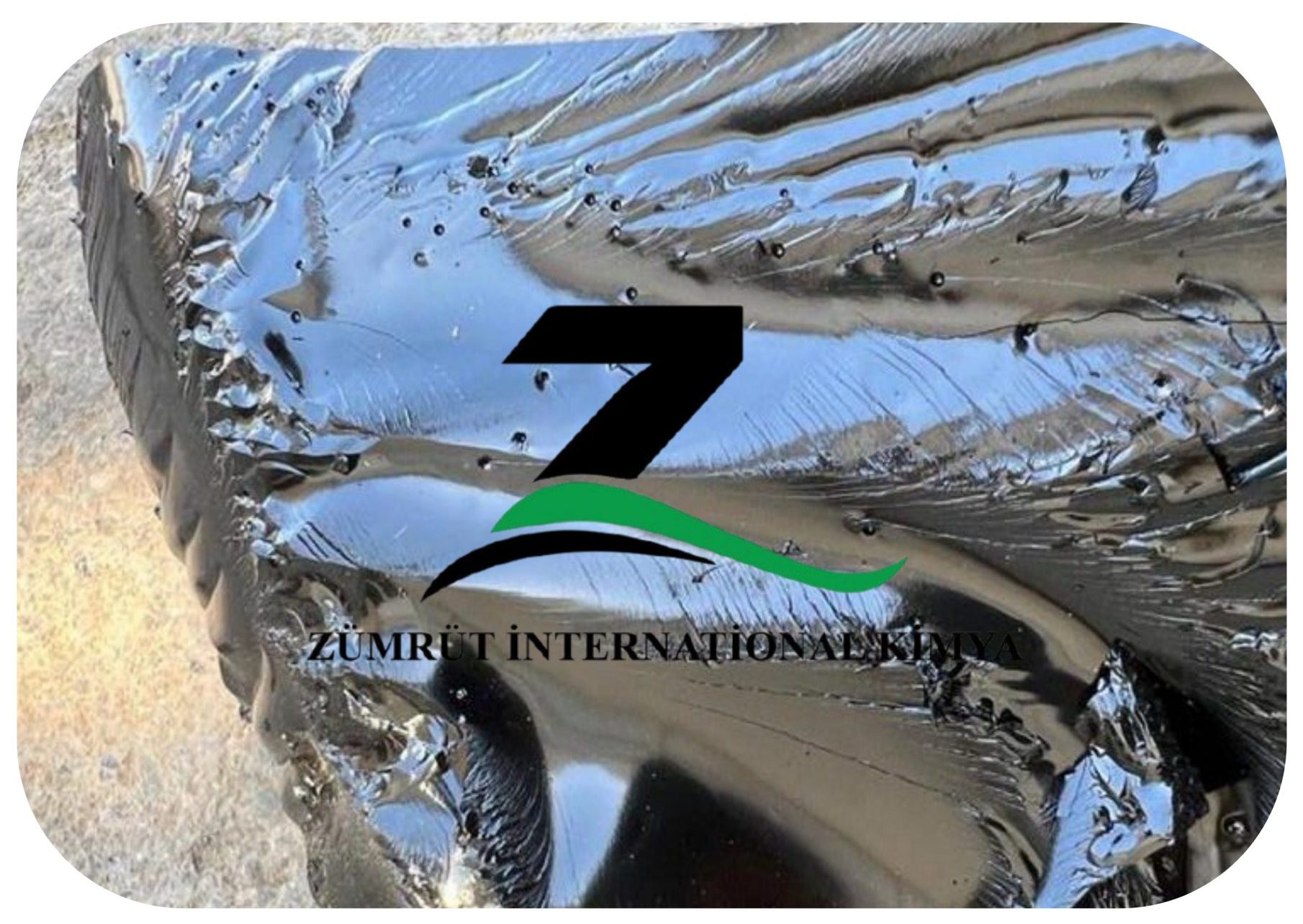
Oxidized Bitumen 85/25, also called blown asphalt 85/25, is a hard industrial grade with a softening point of 80 to 90 °C and a penetration of 20 to 30 dmm at 25 °C. It is made by blowing hot air through penetration grade bitumen, which raises the softening point and cuts temperature sensitivity. It is the standard grade for roofing felt and membrane manufacture, pipe coating and hydraulic sealing in hot climates. ZUMRUT INT Co. supplies it in 25 kg bags and cartons, palletised and shrink-wrapped, with a batch certificate of analysis issued before every shipment.
Oxidized Bitumen 85/25 specification
These are the specification limits we supply against. The sheet is available as a downloadable PDF, and a batch certificate of analysis with the actual test results is issued before every shipment.
| Property | Method | Unit | Specification |
|---|---|---|---|
| Softening point (ring and ball) | ASTM D36 | °C | 80–90 |
| Penetration @25 °C, 100 g, 5 s | ASTM D5 | dmm | 20–30 |
| Specific gravity @25 °C | ASTM D70 | — | 1.05 approx. |
| Ductility @25 °C | ASTM D113 | cm | 3 min |
| Flash point (Cleveland open cup) | ASTM D92 | °C | 250 min |
| Loss on heating | ASTM D6 | wt % | 0.2 max |
| Solubility in CS₂ | ASTM D4 | wt % | 99.5 min |
| Spot test | AASHTO T102 | — | Negative |
How oxidized grades are named
This is the single most common source of confusion at enquiry stage, and it is worth thirty seconds. In an oxidized grade the first number is the softening point in °C and the second is the penetration in dmm. So 85/25 means a binder that softens at about 85 °C and has a penetration of about 25.
Penetration grades work the other way round — 60/70 is a penetration range, not a temperature. A buyer who asks for “bitumen 25/35” or “bitumen 85/35” is almost always working in the oxidized system, and the two numbers tell you immediately how hard the material is and how much heat it will take before it moves.
If you have a specification that names a softening point and a penetration but no grade name, send it to us. Matching it to a standard oxidized grade takes us a minute and it avoids ordering the wrong hardness.
How Oxidized Bitumen 85/25 is produced
Air blowing is the whole process. Penetration grade bitumen is heated to roughly 250–300 °C and air is forced through it in a blowing column. Oxygen reacts with the lighter fractions, the molecular weight rises, and the result is a harder, more rubbery material with a much higher softening point than the feedstock.
Blowing time and air flow rate are what control the finished grade. Longer blowing drives the softening point up and the penetration down. Stopping at the right point is the difference between 85/25 and 85/35, and it is controlled by testing during production rather than by the clock.
The practical consequence for you as a buyer: oxidized bitumen is far less temperature-sensitive than the penetration grade it came from. It stays dimensionally stable on a roof at 60 °C where a paving grade would flow.
Where Oxidized Bitumen 85/25 is used
Roofing felt and membranes
The base bitumen in torch-on felts and modified roll sheets. The high softening point is what stops a membrane creeping on a sloped roof in summer.
Pipe coating
Hot-applied corrosion protection for buried steel pipelines, where adhesion to metal and resistance to soil moisture are the governing requirements.
Hydraulic sealing
Lining and sealing of canals, reservoirs and tunnels, where the material has to stay watertight under permanent contact with water.
Industrial coatings and mastics
A raw material in protective coatings, adhesives, sealants and asphalt-based industrial products.
Rubber and plastic compounding
Used as a filler and extender in rubber goods and certain plastics, where its oxidation resistance matters more than flexibility.
Crack sealing and joint filling
Hot-poured sealing of pavement cracks and expansion joints in regions with moderate thermal movement.
It must be heated to roughly 200–230 °C to reach working viscosity — well above its softening point. That is a deliberate feature, not a drawback: the gap between service temperature and application temperature is exactly what keeps the finished product stable in the sun.
Oxidized Bitumen 85/25 compared with neighbouring grades
Within the oxidized range, the choice is a trade-off between heat resistance and flexibility. Harder grades hold their shape at higher temperature but crack more readily under movement.
| Grade | Softening point | Penetration | Character | Typical use |
|---|---|---|---|---|
| 75/25 | 70–80 °C | 20–30 dmm | Moderate heat resistance | General waterproofing, temperate climates |
| 85/25 | 80–90 °C | 20–30 dmm | Hard, heat resistant | Roofing felt, pipe coating, hot climates |
| 85/35 | 80–90 °C | 30–40 dmm | Same heat, more flexible | Membranes needing movement tolerance |
| 90/40 | 85–95 °C | 35–45 dmm | High softening, softer body | Membrane and board manufacture |
| 115/15 | 110–120 °C | 10–20 dmm | Hardest, most brittle | Electrical insulation, very hot climates |
85/25 or 85/35? They share a softening point, so both behave the same in heat. The difference is penetration: 85/25 is harder and more brittle, 85/35 absorbs movement better. If the substrate moves — a roof deck that expands, a joint that opens — 85/35 is the safer choice. If the requirement is rigidity and heat stability, 85/25 is the one.
Packing and container loading
Oxidized bitumen is a solid at ambient temperature, so it ships as cast blocks in bags or cartons rather than in bulk.
| Packing | Unit | 20′ container | Notes |
|---|---|---|---|
| PP bag, palletised and shrink-wrapped | 25 kg | 22–23 MT | Most common export format; stacks and handles well |
| Kraft paper bag, palletised and shrink-wrapped | 25 kg | 22–23 MT | Recyclable, with an inner coating so the block releases cleanly |
| Carton box, palletised and shrink-wrapped | 25 kg | 22–23 MT | Removable mould, easiest to strip at destination |
All three formats are palletised and shrink-wrapped as standard, which is what keeps blocks from fusing in transit through a hot climate. Other packing formats can be quoted on request; tell us at enquiry stage, because it changes the loading plan and the per-tonne figure.
Our minimum order is two 20′ containers, roughly 45 MT at 22 to 23 MT per container. Mixed oxidized grades within one shipment are accepted provided each grade reaches a full container.
Storage, handling and safety
Stored correctly — under shelter, out of direct sun and rain, in a dry ventilated space, in its original packing and not over-stacked — Oxidized Bitumen 85/25 holds its properties for years. The shelf-life figure on the datasheet is a minimum of 12 months, and in practice the limiting factor is packaging damage rather than the material itself.
Heating. Use indirect heat: an oil-jacketed kettle or a thermostatically controlled melter. Direct flame on the vessel wall overheats the material at the contact point, drives off fume and degrades the binder before the bulk has melted. Do not take a cold charge straight to application temperature; bring it up steadily.
Safety. Hot bitumen causes severe burns and adheres to skin. Heat-resistant gloves, face protection, long sleeves and closed footwear are required wherever the material is handled hot, and heating areas need ventilation to stop vapour accumulating. Do not use water on a bitumen fire — it flashes to steam and ejects burning material; dry powder and foam are the correct media. Full handling, exposure and first-aid guidance is in the material safety data sheet, which we also issue with every shipment.
Payment, inspection and documentation
Our standard terms are 50% by TT in advance, balance against a copy of the Bill of Lading. The advance secures production and loading; the balance falls due once the cargo is demonstrably on the water and documented. We do not work on letters of credit — bank charges and discrepancy risk end up in the per-tonne figure, and saying so plainly saves a week of negotiation.
Every shipment travels with a commercial invoice, packing list, bill of lading, certificate of origin, safety data sheet and the batch certificate of analysis. SGS, Bureau Veritas, Intertek or the surveyor named in your contract can attend loading for quality and quantity. Shipping documents are issued within three days of vessel departure. The export documentation guide sets out what each document does and where presentations usually fail.
We load from Jebel Ali, Mersin and Iskenderun, and the port we quote from depends on the destination and the packing you choose. The exact port and sailing are confirmed with the quotation.
Frequently asked questions about Oxidized Bitumen 85/25
What are the specifications of Oxidized Bitumen 85/25?
Softening point 80–90 °C (ASTM D36), penetration 20–30 dmm at 25 °C (ASTM D5), specific gravity about 1.05 (ASTM D70), ductility 3 cm minimum (ASTM D113), flash point 250 °C minimum (ASTM D92), loss on heating 0.2% maximum (ASTM D6), solubility in CS₂ 99.5% minimum (ASTM D4), spot test negative. The full sheet is a downloadable PDF.
What do the numbers 85 and 25 mean?
In oxidized grades the first number is the softening point in °C and the second is the penetration in dmm. So 85/25 softens at about 85 °C and has a penetration of about 25. This is the opposite convention to penetration grades such as 60/70, where both numbers describe penetration.
What is the difference between 85/25 and 85/35?
Both soften at about the same temperature. 85/25 has a penetration of 20–30 dmm and is harder and more brittle; 85/35 has 30–40 dmm and tolerates movement better. Choose 85/35 where the substrate moves, 85/25 where rigidity and heat stability matter most.
Is Oxidized Bitumen 85/25 the same as blown asphalt?
Yes. Blown asphalt, blown bitumen and oxidized bitumen are the same product under different names, from the air-blowing process used to make it. Suppliers and specifications use the terms interchangeably.
At what temperature is it applied?
Roughly 200 to 230 °C, which is well above its 80–90 °C softening point. Heat it indirectly in an oil-jacketed kettle or thermostatically controlled melter, and bring a cold charge up steadily rather than quickly.
Can it be used in cold climates?
What is the minimum order quantity?
Two 20′ containers, roughly 45 MT in total at 22 to 23 MT per container. Mixed oxidized grades in one shipment are accepted provided each grade reaches a full container.
What are your payment terms?
50% by TT in advance with the balance settled against a copy of the Bill of Lading. We do not work on letters of credit. The balance falls due only once the cargo is on the water and documented.
Is a certificate of analysis provided?
Yes, with every shipment. It carries the lot number and production date and reports the actual test results for softening point, penetration, specific gravity, ductility, flash point, loss on heating and solubility — not generic typical values.
How long does it keep in storage?
A minimum of 12 months under correct storage, and considerably longer in practice. Keep it sheltered, dry, out of direct sunlight, in its original packing and not over-stacked. The usual cause of loss is damaged packaging or blocks fusing in heat, not the material ageing.
Can you supply bulk rather than bagged?
Oxidized bitumen is solid at ambient temperature, so it ships as cast blocks in 25 kg bags or cartons rather than in bulk. If your plant is set up for a different format, tell us at enquiry stage and we will tell you what can be arranged.
What is the price of Oxidized Bitumen 85/25?
It moves with feedstock cost, ocean freight, packing choice and destination, so a flat published number would not hold. Indicative levels are on our bitumen price page. Send quantity, packing, destination port and Incoterm and we issue a firm FOB, CFR or CIF quotation within one business day.
Related grades and products
Oxidized Bitumen 85/35
Same softening point, higher penetration. 85/35 is the choice where the substrate moves and the membrane has to follow it.
Oxidized Bitumen 90/40
90/40 combines a high softening point with a softer body, widely used in membrane and board manufacture.
Oxidized Bitumen 115/15
115/15 is the hardest common grade, for electrical insulation and the hottest climates.
All oxidized grades
The full range and how to choose between them is on the oxidized bitumen overview page.
Bitumen roll sheet
Finished SBS and APP membranes, if you are buying the product rather than the raw material.
Penetration grades
60/70 is the feedstock oxidized grades are blown from, and the standard paving binder in warm climates.
Request a quotation for Oxidized Bitumen 85/25
Send us the quantity in MT, the packing format, the destination port and the Incoterm. We come back with a firm price, a production schedule and the documentation list for clearance within one business day. If you have a softening point and penetration requirement but no grade name, send the specification instead and we will match it.
Dubai +971 4 566 4998 · Ankara +90 507 246 9520
