
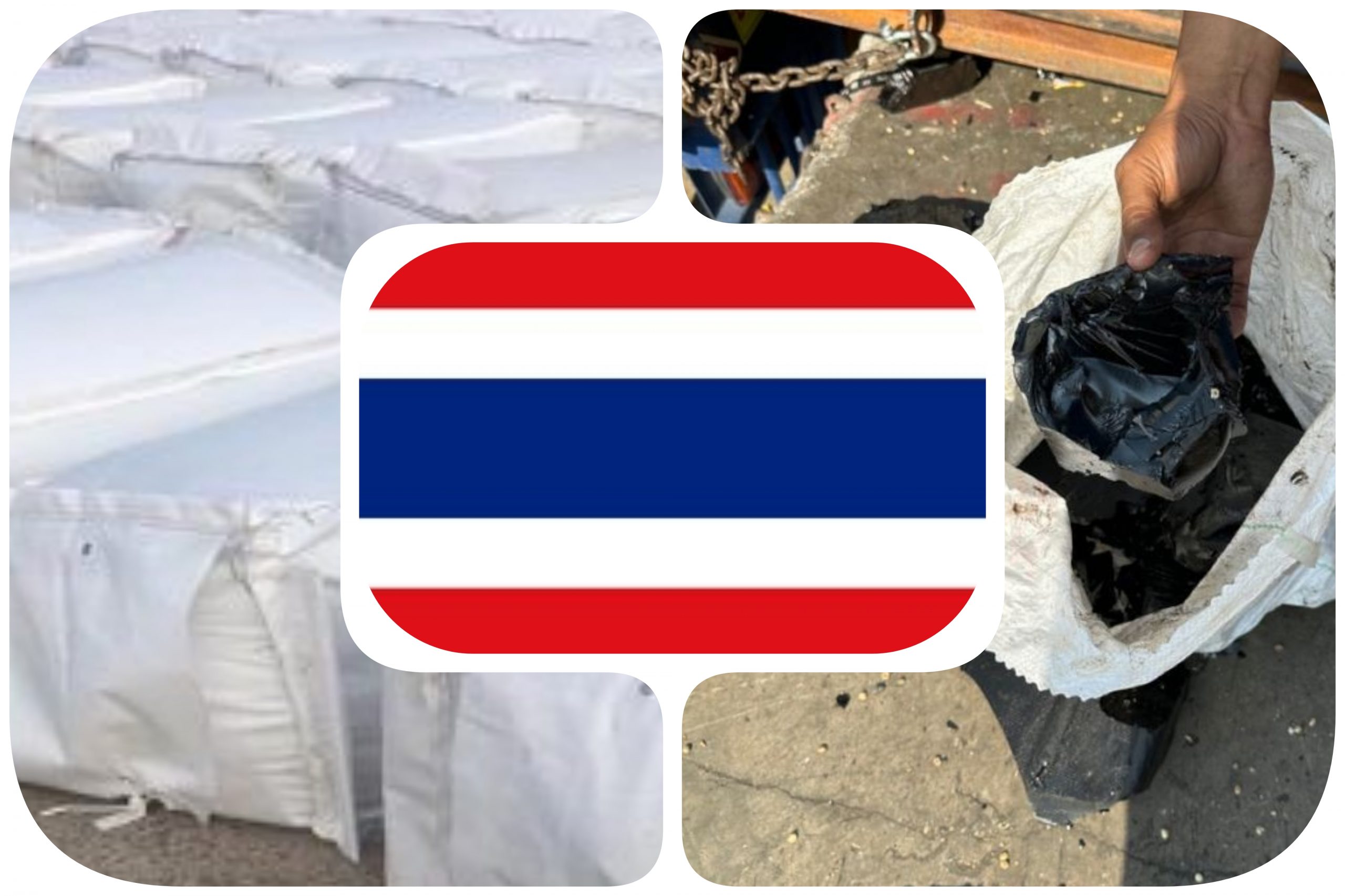
An oxidized bitumen supplier in Thailand is solving a humidity problem, not a heat problem. Thailand’s peak temperatures are moderate by oxidized bitumen standards — a 90/40 grade softens at 90 °C and the roof will never reach it. What actually governs is that the substrate is rarely dry. In a climate with year-round humidity and a monsoon season, adhesion to damp surfaces is the failure mode, and it is where grade selection and application timing matter most.
ZUMRUT INT Co. supplies the full range of oxidized bitumen grades into Thailand, loading from Mersin. Every shipment carries a batch certificate of analysis issued before loading, stating the measured softening point and penetration rather than a typical-values range.
What oxidized bitumen is
Oxidized bitumen — also called blown bitumen or blown asphalt — is produced by blowing air at high temperature through penetration-grade bitumen. The process builds molecular weight and produces a material that is markedly less temperature-sensitive than the feedstock it came from.
The result is semi-solid to solid at ambient temperature, with a high softening point and low penetration. It resists flow under heat and pressure, which is why it suits industrial and structural applications where the binder must hold its shape rather than deform.
A correction worth making, because it appears in a lot of supplier material. Oxidation does not make bitumen more elastic. It makes it harder and stiffer — higher softening point, lower penetration, reduced ductility. That stiffness is the useful property: it is what stops the material flowing off a hot roof or sagging on a vertical pipe. If your application genuinely needs elasticity and recovery, that is polymer modified bitumen or an SBS membrane, not oxidized grade. Getting this distinction right avoids specifying the wrong material for a moving joint.
Why humidity, not heat, drives the Thai specification
Most material on this subject says oxidized bitumen suits Thailand because it resists heat. That is true but not the point — Thailand’s ambient temperatures rarely trouble a material with an 85 °C-plus softening point.
The real constraints are different.
| Condition | What it does | What it means for the job |
|---|---|---|
| Year-round high humidity | Substrates rarely reach genuinely dry | The governing constraint. Adhesion failure on damp concrete is the most common cause of waterproofing failure here |
| Monsoon season | Extended periods where application is impractical | Compresses the working window. Material has to be on site and ready when conditions allow |
| Intense rainfall events | Water finds any weakness in the membrane or seal | Lap joints and detailing matter more than the bulk material specification |
| Roof surface temperature | Dark surfaces in direct sun reach 65–75 °C | 85/25 is adequate for most roofing; only unusual exposure calls for harder |
| Storage humidity | Moisture ingress into packaging in warehouses | Packing specification matters as much for storage as for transit |
| Biological growth | Algae and moss on damp horizontal surfaces | Affects long-term appearance and drainage rather than the binder itself |
The practical consequence for application
Surface preparation carries more weight in Thailand than in a dry climate. Concrete that looks dry can hold enough moisture to defeat the bond, and the failure shows up as blistering and delamination months later rather than immediately.
This is also why the working window matters commercially. If your programme depends on applying during a narrow dry spell, having material already in the warehouse is worth more than a marginally better price on a shipment that arrives mid-monsoon.
Grade selection
Oxidized grades are named by softening point and penetration: the first number is the softening point in degrees Celsius, the second the penetration in tenths of a millimetre. So 85/25 softens at about 85 °C with penetration around 25.
| Grade | Softening point | Character | Application in Thailand |
|---|---|---|---|
| 85/25 | ~85 °C | Balanced — hard but workable | The volume grade. Roofing, general waterproofing, membrane manufacture |
| 90/40 | ~90 °C | Higher softening point with retained flexibility | Foundation damp proofing, substrates that move, below-grade work |
| 90/15 | ~90 °C | Harder, lower penetration | Adhesives and bonding compounds where the joint carries load |
| 95/25 | ~95 °C | Higher heat resistance | Exposed roofing with severe solar gain, industrial roofs |
| 105/35 | ~105 °C | Very hard, some flexibility retained | Specialist industrial, high-temperature service |
| 115/15 | ~115 °C | Hardest standard grade | Pipe coating enamel for oil, gas and water pipelines |
| 150/5 | ~150 °C | Extremely hard and brittle | Specialist industrial uses only |
Do not over-specify the softening point. A harder grade is not a safer choice. Higher softening point comes with lower penetration and reduced ductility, so the material becomes more brittle — and a brittle waterproofing layer cracks where the substrate moves or where it is stressed at a detail. Specify the grade the service temperature requires and no harder. For most Thai roofing, that is 85/25; reaching for 115/15 buys brittleness you do not need.
Selection by application
| Application | Grade | Reasoning |
|---|---|---|
| Roofing membrane manufacture | 85/25 | The standard feedstock. Works with both APP and SBS modification |
| Roof waterproofing, direct application | 85/25 | Adequate for Thai roof surface temperatures with workability for application |
| Exposed industrial roofing | 95/25 | Where severe solar gain pushes surface temperature higher |
| Foundation and below-grade | 90/40 | Retained flexibility for substrate movement and settlement |
| Basement tanking | 90/40 | Continuous water contact and hydrostatic pressure; flexibility matters |
| Pipe coating, oil and gas | 115/15 | Anti-corrosion enamel. Hardness resists soil stress and handling damage |
| Water pipeline coating | 115/15 or 105/35 | Depends on the coating specification and service conditions |
| Adhesives and bonding | 90/15 | Holds under load with tolerance for slight movement |
| Expansion joints | 90/40 or PMB | A joint by definition moves. If movement is significant, PMB rather than oxidized |
| Flooring and insulation bonding | 90/15 or 85/25 | Depends on service temperature and whether the substrate moves |
| Industrial and port flooring | 90/15 in mastic asphalt | High softening point with low penetration gives the hardness mastic flooring needs |
Applications across Thai industry
-
Roofing and waterproofing
Membrane manufacture and direct application across residential, commercial and industrial construction.
-
Pipeline coating
Anti-corrosion enamel for oil, gas and water pipelines — a substantial application given Thailand’s energy infrastructure.
-
Below-grade waterproofing
Foundations, basements and tanking, where high groundwater makes the requirement continuous.
-
Expansion joints
Road, bridge and building joints, where thermal movement has to be accommodated.
-
Industrial flooring
Mastic asphalt flooring in factories, warehouses and port facilities.
-
Adhesives and bonding
Flooring, insulation and panel bonding compounds.
-
Marine and port
Waterproofing and protective coating in coastal and port infrastructure exposed to salt air.
-
Airport and runway
Joint sealing and specialist waterproofing in aviation infrastructure.
Ports and logistics
| Port | Serves | Notes |
|---|---|---|
| Laem Chabang | Bangkok, the Eastern Economic Corridor, most of the country | Thailand’s principal deep-sea port. Best connectivity, most frequent services, efficient clearance |
| Bangkok (Khlong Toei) | The capital and central region | Closer to the city but draft-limited. Suits smaller parcels where the inland leg from Laem Chabang matters |
| Map Ta Phut | The Rayong industrial complex | Industrial and petrochemical focus. Relevant where the project is in that zone |
| Songkhla | The southern provinces | Shortens the inland leg substantially for southern projects and Malaysian border trade |
| Phuket | Andaman coast and tourism development | Limited capacity. Usually reached overland from Laem Chabang |
Laem Chabang is the default for good reason — deep-water capacity, modern handling, strong inland connections to Bangkok, Chiang Mai and the industrial zones. But for a southern project, Songkhla can save several hundred kilometres of trucking, and that saving usually exceeds any difference in freight.
Transit time is the planning constraint
Thailand is 28 to 40 days from Mersin by sea, depending on routing and transhipment. That is one of the longer transits we handle, and it interacts with the monsoon.
If your application window is a dry-season month, the order has to be placed roughly two months ahead. Ordering in response to a window that has already opened means the material arrives after it closes. We flag this at the enquiry stage rather than after the fact.
Packing for a humid climate
| Packing | Detail | Suitability for Thailand |
|---|---|---|
| Kraft paper wrapped block | 25 kg blocks, kraft-wrapped, palletised | Standard. Melts with the wrapping — no unwrapping step at the kettle |
| Carton packing | Blocks in cartons on pallet | Better protection in humid warehouse storage; easier stacking |
| Polybag | Blocks in polythene | Good moisture barrier, but must be removed before melting |
| Steel drum | 180–200 kg drums | Best protection for long storage; higher cost per tonne |
| Jumbo bag | Bulk bagged | Only where handling equipment is available and use is immediate |
In a humid climate the packing has two jobs: protecting the cargo over a long sea transit, and protecting it in warehouse storage before use. If the material will sit for months waiting for a dry application window, specify carton or drum rather than plain kraft. The difference in packing cost is small against the risk of degraded material at the point of use.
Price of oxidized bitumen in Thailand
| Cost component | Moves with | Notes |
|---|---|---|
| Base bitumen price | Crude and vacuum bottom | The feedstock cost. Tracks crude with a lag of a few weeks |
| Blowing process | Energy and processing time | Oxidized grades carry a differential over penetration grade reflecting the air-blowing step |
| Grade differential | Softening point | Higher softening point means longer blowing. 115/15 costs more than 85/25 |
| Ocean freight | Southeast Asia trade lane | Among the lowest bands globally — these routes carry enormous volume in both directions |
| Packing | Kraft, carton, polybag or drum | Drum and carton cost more but protect better in humid storage |
| Import duty and taxes | Thai tariff and VAT | HS 2713.20. Confirm the current rate with your broker |
| Inland transport | Distance from the discharge port | Modest from Laem Chabang to Bangkok; significant to Chiang Mai or the deep south |
Indicative CFR levels for Thailand and more than forty other markets are on our bitumen price by country page.
Importing oxidized bitumen into Thailand
Thailand does not operate a pre-shipment verification of conformity scheme of the kind Nigeria or Kenya use. Clearance runs on standard customs documentation.
| Document | Issued by | Purpose |
|---|---|---|
| Commercial invoice | Seller | Value, parties, Incoterm, HS code |
| Packing list | Seller | Block or drum count, net and gross weight, container and seal numbers |
| Bill of lading | Shipping line | Title and contract of carriage |
| Certificate of origin | Chamber of commerce at origin | Country of production; determines duty treatment |
| Certificate of analysis | Producer QC or independent lab | Measured softening point and penetration for the batch, against ASTM D312 or the project specification |
| Safety data sheet | Producer | Hazard and handling information |
| Inspection certificate | SGS, Bureau Veritas, Intertek | Independent quality and quantity verification at loading |
For oxidized grades the certificate of analysis matters more than for penetration grades, because the grade designation is the specification. A batch labelled 85/25 that measures 78 °C softening point is a different product from the one you ordered, and you will find out on the roof rather than at the port. We state measured values with the lot number and production date. The full documentation picture is in our export documentation guide.
Why choose ZUMRUT as your oxidized bitumen supplier in Thailand
Payment terms are 30% by TT in advance with the balance settled against a copy of the bill of lading, and an irrevocable letter of credit at sight for repeat contracts. The balance falls due only once the cargo is on the water and documented.
- Measured softening point and penetration on the batch certificate, with lot number and production date — not a typical-values sheet. For oxidized grades this is the whole specification.
- Grade advice that says when you are over-specifying — a harder grade is more brittle, and brittleness cracks at details. We will say so rather than sell you the more expensive grade.
- Transit planning against the monsoon — 28 to 40 days means ordering roughly two months before your application window, and we flag that at enquiry.
- Packing matched to humid storage, not just to the sea voyage.
- Delivery to whichever port suits the project — Laem Chabang, Bangkok, Map Ta Phut or Songkhla — rather than defaulting to the largest.
- Full grade range from one supplier, so a project needing 85/25 for roofing and 115/15 for pipe coating ships together.
- Third-party inspection accepted at the load port by SGS, Bureau Veritas, Intertek or the surveyor you name.
- Minimum order 100 MT. Mixed grades accepted where each grade fills a container.
Frequently asked questions
What is oxidized bitumen?
Bitumen that has had air blown through it at high temperature, which builds molecular weight and produces a material far less temperature-sensitive than the feedstock. It is semi-solid to solid at ambient temperature with a high softening point and low penetration. Also called blown bitumen or blown asphalt.
Does oxidation make bitumen more elastic?
No — the opposite. Oxidation makes bitumen harder and stiffer: higher softening point, lower penetration, reduced ductility. That stiffness is the useful property, because it stops the material flowing off a hot roof or sagging on a vertical pipe. If the application needs genuine elasticity and recovery, that is polymer modified bitumen or an SBS membrane, not oxidized grade.
Which oxidized bitumen grade is best for Thailand?
85/25 for most roofing and general waterproofing — it handles Thai roof surface temperatures with good workability. 90/40 for foundations and below-grade work where the substrate moves. 95/25 for exposed industrial roofs with severe solar gain. 115/15 for pipe coating. Going harder than the service temperature requires buys brittleness rather than safety.
Why is humidity more important than heat for oxidized bitumen in Thailand?
Because Thai ambient temperatures rarely trouble a material with an 85 °C-plus softening point, while humidity is constant. Substrates rarely reach genuinely dry, and adhesion failure on damp concrete is the most common cause of waterproofing failure here. Surface preparation carries more weight than in a dry climate, and the failure typically shows up as blistering months later rather than immediately.
What do the numbers in 85/25 mean?
The first is the softening point in degrees Celsius, the second the penetration in tenths of a millimetre. So 85/25 softens at about 85 °C with penetration around 25. Higher first number means more heat resistance; lower second number means harder and less ductile.
Why not always specify the hardest grade?
Because higher softening point comes with lower penetration and reduced ductility, so the material becomes more brittle. A brittle waterproofing layer cracks where the substrate moves or where it is stressed at a detail. Specify what the service temperature requires and no harder — for most Thai roofing that is 85/25.
Which port should oxidized bitumen be discharged at in Thailand?
Laem Chabang for most destinations — deep-water capacity, modern handling and strong inland connections to Bangkok, Chiang Mai and the industrial zones. Bangkok for smaller parcels destined for the capital. Map Ta Phut for Rayong industrial projects. Songkhla for southern projects, where it saves several hundred kilometres of trucking.
How long does shipping to Thailand take?
28 to 40 days from Mersin depending on routing and transhipment. That interacts with the monsoon: if the application window is a dry-season month, the order has to be placed roughly two months ahead. Ordering in response to a window that has already opened means the material arrives after it closes.
What packing is best for humid conditions?
Kraft paper wrapped blocks are standard and melt with the wrapping. For material that will sit in storage waiting for a dry application window, carton or steel drum gives better protection against warehouse humidity. The difference in packing cost is small against the risk of degraded material at the point of use.
Does Thailand require a certificate of conformity?
No. Thailand does not operate a pre-shipment verification of conformity scheme like Nigeria’s SONCAP or Kenya’s PVoC. Clearance runs on standard customs documentation. What matters on the supply side is a batch certificate of analysis with measured softening point and penetration.
Why does the certificate of analysis matter more for oxidized grades?
Because the grade designation is the specification. A batch labelled 85/25 that actually measures 78 °C softening point is a different product from the one ordered, and it will be discovered on the roof rather than at the port. Ask for measured values with lot number and production date rather than a typical-values range.
What is the HS code for oxidized bitumen in Thailand?
Petroleum bitumen, including oxidized grades, falls under HS 2713.20. Thai tariffs add further digits and VAT applies, so confirm the full code and current rate with your customs broker before contracting.
Related pages
Oxidized grades: oxidized bitumen overview, 85/25, 90/40, 90/15, 95/25, 105/35, 115/15 and 150/5.
Related products: bitumen 60/70, polymer modified bitumen, APP membrane, bitumen membrane and emulsion. For comparing oxidized against penetration grade, see oxidized vs penetration bitumen. For storage limits, see the shelf life and storage guide.
Regional markets we also supply: Togo, Namibia, Morocco and Tunisia. Indicative pricing for more than forty markets is on our bitumen price by country page, and the full network in our global bitumen supply guide.
Order oxidized bitumen for Thailand
Send us the grade, the quantity, the packing and the discharge port. Tell us when your application window is — at 28 to 40 days transit, ordering two months ahead of a dry-season programme is the difference between material on site and material arriving mid-monsoon. We will confirm the measured softening point and penetration the certificate will state before you commit.
Dubai +971 4 566 4998 · Ankara +90 507 246 9520
