
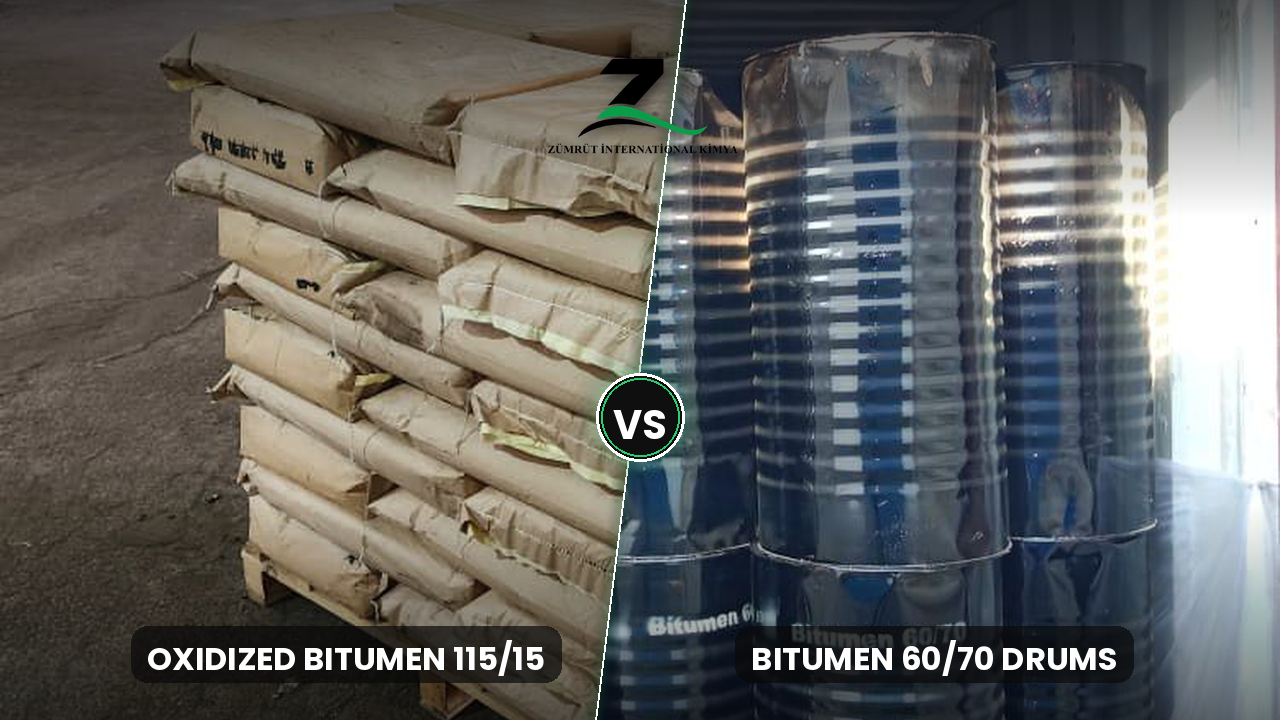
Oxidized bitumen vs penetration bitumen is not a question of which is better. They are different products made by different processes for different jobs. Penetration bitumen is straight-run refinery bottoms, graded on how soft it is at 25 °C, and it goes into roads. Oxidized bitumen is that same material blown with air until it hardens, graded on softening point and penetration together, and it goes into roofs, pipes and industrial compounds. Substituting one for the other does not produce a worse road or a worse roof — it produces a failure.
This guide sets out the oxidized bitumen vs penetration bitumen comparison properly: how each is made, why the grading systems differ, what happens physically when you substitute one for the other, and a decision table that tells you which grade your application actually needs. ZUMRUT INT Co. supplies both families, so the answer here is not a sales pitch for one over the other.
Oxidized bitumen vs penetration bitumen: the core difference
| Penetration bitumen | Oxidized bitumen | |
|---|---|---|
| How it is made | Vacuum distillation residue, blended to grade | Penetration bitumen blown with air at 240–260 °C |
| Also called | Paving grade, straight-run bitumen | Blown bitumen, blown asphalt, air-blown bitumen |
| Grade designation | Penetration range only — 60/70 means 60–70 dmm | Softening point / penetration — 115/15 means 115 °C and 15 dmm |
| Softening point | Typically 45–60 °C | Typically 70–155 °C |
| Penetration @25 °C | Typically 20–300 dmm | Typically 5–45 dmm |
| Penetration Index | Roughly −1 to +1 | Above +2, often much higher |
| Colloidal structure | Sol type — asphaltenes dispersed | Gel type — asphaltene network |
| Behaviour with temperature | Softens progressively; high temperature susceptibility | Holds consistency across a wide range; low susceptibility |
| Primary use | Hot mix asphalt, road paving, surface dressing | Roofing membrane, waterproofing, pipe coating, industrial compounds |
| Suitable for roads? | Yes — this is what roads are made of | No — too brittle, poor fatigue resistance |
| Suitable for roofing? | No — flows and sags at roof surface temperature | Yes — this is what membrane is made of |
The one-sentence version. Penetration bitumen stays flexible and fatigues well but softens in heat. Oxidized bitumen holds its shape in heat but has almost no fatigue resistance. Roads flex millions of times and rarely exceed 60 °C at depth. Roofs barely move but reach 80 °C on a dark surface. Each product is built for one of those conditions.
How each one is produced
Penetration bitumen: distillation
Crude oil goes through atmospheric distillation, which removes the light fractions. The heavy residue then goes to a vacuum distillation unit, where reduced pressure allows further separation without cracking the molecules. What comes off the bottom is penetration grade bitumen. The grade is set by how deep the vacuum cut is taken and by blending — a softer cut gives 80/100, a deeper cut gives 40/50.
Nothing is chemically changed. The molecules present in the crude are simply separated by boiling point. That is why penetration bitumen retains a sol-type colloidal structure with asphaltenes dispersed in a maltene medium, and why it behaves as a viscoelastic material that flows under sustained load.
Oxidized bitumen: air blowing
Penetration grade bitumen, usually 60/70, is charged into a blowing tower and heated to 240–260 °C. Hot compressed air is injected through perforated pipes at the base. Oxygen reacts with hydrogen in the hydrocarbon chains, forming water and carbonyl and sulfoxide groups. Lighter aromatic and resin fractions convert into heavier polar species and the asphaltene content rises sharply.
This is a chemical change and it is irreversible. The asphaltenes link into a continuous network, converting the colloidal structure from sol to gel. The result is a material with a much higher softening point, much lower penetration and a fundamentally different response to temperature.
Production stops when both the softening point and the penetration fall simultaneously inside the target window — which is why oxidized grades carry two numbers and penetration grades carry one.
Why the grading systems are different
This trips up more buyers than any other aspect of the oxidized bitumen vs penetration bitumen comparison.
Penetration bitumen needs one number because its softening point follows predictably from its penetration. A 60/70 binder will land around 49–56 °C softening point almost regardless of where it was refined. The relationship is tight enough that one measurement describes the material.
Oxidized bitumen needs two numbers because that relationship breaks. Blowing raises the softening point far faster than it lowers the penetration, and how far it does each depends on the feedstock and the blowing conditions. Two grades can share a softening point and differ completely in hardness — 105/35 and 105/15 both sit at 105 °C, but one is flexible enough for membrane and the other cracks at the fold.
Penetration Index: the number that explains everything
Penetration Index (PI) is calculated from penetration and softening point together, and it measures temperature susceptibility — how much the binder’s consistency changes as temperature changes.
| Penetration Index | Material | What it means |
|---|---|---|
| Below −2 | Highly temperature susceptible | Consistency changes sharply with temperature. Poor paving performance |
| −1 to +1 | Standard penetration grades | Normal paving binder. Sol structure, good fatigue resistance |
| +2 and above | Oxidized grades | Gel structure. Low temperature susceptibility, holds shape in heat, poor fatigue resistance |
| Above +4 | Hard oxidized grades | 115/15 and harder. Effectively a rigid resin at ambient |
A high PI is exactly what you want on a roof and exactly what you do not want on a road. That single fact is the whole comparison in one line.
What happens when you substitute one for the other
These are not theoretical failures. They are what the material physically does.
| Substitution | What you see | When | Why |
|---|---|---|---|
| Oxidized used in road paving | Transverse and block cracking, ravelling, aggregate loss, brittle failure at joints | First or second winter | Gel structure has almost no fatigue resistance. Traffic loading flexes the pavement millions of times and the binder fractures rather than recovering |
| Penetration used in roofing membrane | Sheet sags, flows at the laps, bleeds through the surfacing, slides on a pitched roof | First hot season | Softening point of 49–56 °C is below the surface temperature of a dark roof in summer |
| Penetration used in pipe coating | Coating creeps, thins on the upper surface, disbonds under soil load | Within months of backfill | No resistance to sustained static load at ground temperature |
| Oxidized used in surface dressing | Chip loss, stripping, bare patches | First winter | Insufficient ductility to hold aggregate through thermal cycling |
| Hard oxidized in a flexible joint | Sealant cracks and the joint opens | First seasonal cycle | Joint movement exceeds what a gel-structure binder can accommodate |
Which do you need? A decision table
| Application | Family | Typical grade |
|---|---|---|
| Hot mix asphalt, highways | Penetration | 60/70, 40/50 in hot climates |
| Low-volume and rural roads | Penetration | 80/100, 100/150 |
| Surface dressing, chip seal | Penetration | 80/100 or emulsion |
| Prime and tack coat | Penetration derivative | Cutback or emulsion |
| Airport pavement, heavy corridors | Penetration / modified | 40/50 or PMB |
| Roofing felt and membrane | Oxidized | 85/25, 90/40, 105/35 |
| Membrane for hot climates | Oxidized | 105/35, 115/15 |
| Pipe coating enamel | Oxidized | 105/15, 115/15, 90/10 |
| Below-grade waterproofing | Oxidized | 95/25, 105/35 |
| Electrical and battery compounds | Oxidized | 150/5, 115/15 |
| Industrial mastic and flooring | Oxidized | 105/15, 115/15 |
| Rubber compounding | Oxidized | 150/5 |
Penetration grade range
Graded on penetration alone. Softer grades for cold climates and light traffic, harder grades for heat and heavy loading.
| Grade | Penetration @25 °C | Standard | Typical use |
|---|---|---|---|
| 30/40 | 30–40 dmm | ASTM D946 | Extreme heat, industrial hardstanding |
| 40/50 | 40–50 dmm | ASTM D946 | Hot climates, airports, heavy slow loading |
| 60/70 | 60–70 dmm | ASTM D946 | The global default for highways and urban roads |
| 80/100 | 80–100 dmm | ASTM D946 | Spray work, prime coats, low-traffic roads |
| 50/70 | 50–70 dmm | EN 12591 | European equivalent of 60/70 |
| 70/100 | 70–100 dmm | EN 12591 | Moderate traffic, cooler climates |
| 160/220 | 160–220 dmm | EN 12591 | Cold regions, emulsion and cutback base |
The full range with specifications is on our penetration grade bitumen page, split by ASTM D946 and EN 12591.
Oxidized grade range
Graded on softening point and penetration together. The first number sets heat resistance; the second sets how much movement the grade tolerates.
| Grade | Softening point | Penetration | Typical use |
|---|---|---|---|
| 150/5 | 145–155 °C | 0–10 dmm | Electrical compounds, battery sealing, rubber |
| 115/15 | 110–120 °C | 10–20 dmm | Waterproofing, adhesives, pipe coating |
| 105/35 | 100–110 °C | 30–40 dmm | Roofing felt and membrane in hot climates |
| 105/15 | 100–110 °C | 10–20 dmm | Sealing, jointing, industrial mastics |
| 95/25 | 90–100 °C | 20–30 dmm | Roofing membrane, damp proofing |
| 90/40 | 85–95 °C | 35–45 dmm | Roofing felt, membrane in cooler climates |
| 90/10 | 85–95 °C | 5–15 dmm | Pipe coating, industrial compounds |
| 85/25 | 80–90 °C | 20–30 dmm | The volume roofing grade worldwide |
| 75/25 | 70–80 °C | 20–30 dmm | General waterproofing, jointing |
The full range is on our oxidized bitumen page.
Testing: what each certificate should show
| Test | Method | On penetration bitumen | On oxidized bitumen |
|---|---|---|---|
| Penetration @25 °C | ASTM D5 | Defines the grade | Second number of the grade |
| Softening point | ASTM D36 | Reported, follows from penetration | First number of the grade |
| Ductility @25 °C | ASTM D113 | Critical — typically 100 cm min | Reported only, often not specified |
| Loss on heating | ASTM D6 | 0.2% max typical | 0.5% max typical |
| Flash point | ASTM D92 | 232 °C min typical | 230–300 °C min by grade |
| Solubility | ASTM D2042 | 99% min | 99% min |
| Governing standard | — | ASTM D946, EN 12591 | ASTM D312, BS EN 13304 |
The ductility row is the tell. A penetration grade certificate without a ductility figure is incomplete, because ductility is what holds aggregate on a road. An oxidized grade certificate often reports it as information only, because at 15 dmm the material fractures rather than stretching and the number carries little meaning. If someone hands you an oxidized certificate showing 100 cm ductility, something is wrong with the document.
Storage and handling: also different
| Penetration bitumen | Oxidized bitumen | |
|---|---|---|
| Shelf life, sealed packing | About 24 months | 24–36 months |
| Why the difference | Still has maltenes left to oxidize | Already blown — little left to react |
| Usual packing | 180/200 kg drums, jumbo bags, bulk | 25 kg kraft bags, cartons, drums |
| Bulk hot storage | 3–5 days at working temperature | Not held hot — melted per batch |
| Melting temperature | 140–160 °C | 170–245 °C by grade |
| Main storage risk | Water ingress at the bung; oxidative hardening in hot tanks | Blocks fusing under stacking pressure in heat |
The full picture, including retest thresholds for material that has been sitting, is in our bitumen shelf life and storage guide.
Customs and documentation: identical
Both families fall under HS 2713.20, petroleum bitumen. Neither is classified as dangerous goods when shipped bagged or drummed at ambient temperature, though bulk bitumen carried hot at or above 100 °C is UN 3257, Class 9. The document set is the same for both — invoice, packing list, bill of lading, certificate of origin and a batch certificate of analysis. Details are in our bitumen export documentation guide.
Note that gilsonite and other naturally occurring hard bitumen fall under a different heading, 2714.90, and are neither penetration nor oxidized grades — they are mined rather than refined.
What we supply
ZUMRUT INT Co. ships both families from Jebel Ali, Mersin and Bandar Abbas. Penetration grades to ASTM D946 and EN 12591, viscosity grades to IS 73, performance grades to AASHTO M320, and the full oxidized range from 75/25 through 150/5 to ASTM D312 and BS EN 13304.
Every shipment carries a batch certificate of analysis with the lot number, production date and each test with its measured result against the standard your contract names. Minimum order 100 MT, FOB, CFR or CIF. Mixed grades in one shipment are accepted provided each grade fills a container.
Frequently asked questions
What is the difference between oxidized bitumen and penetration bitumen?
Penetration bitumen is produced by vacuum distillation of crude oil and graded on penetration alone, for example 60/70. Oxidized bitumen is penetration bitumen that has been blown with hot air at 240 to 260 °C until it hardens, and it is graded on softening point and penetration together, for example 115/15. The blowing converts the colloidal structure from sol to gel, which raises heat resistance dramatically but destroys fatigue resistance. Penetration grades go into roads; oxidized grades go into roofing, pipe coating and industrial compounds.
Can oxidized bitumen be used for road construction?
No. Its gel-type structure has almost no fatigue resistance, so under traffic loading the binder fractures rather than recovering. The pavement develops transverse and block cracking and ravels, typically within the first or second winter. Road paving needs a penetration, viscosity or performance grade binder.
Can penetration bitumen be used for roofing?
Not for membrane or waterproofing. Penetration grades have a softening point of roughly 45 to 60 °C, which is below the surface temperature of a dark roof in summer. The sheet sags, flows at the laps and bleeds through the surfacing in the first hot season. Roofing needs an oxidized grade, typically 85/25, 90/40 or 105/35 depending on climate.
Why does oxidized bitumen have two numbers and penetration bitumen only one?
For penetration grades, softening point follows predictably from penetration, so one measurement describes the material. Blowing breaks that relationship: it raises the softening point much faster than it lowers the penetration, and how far it does each depends on feedstock and blowing conditions. Two oxidized grades can share a softening point and differ completely in hardness, so both numbers are needed.
What is Penetration Index and why does it matter?
Penetration Index is calculated from penetration and softening point together and measures temperature susceptibility. Standard penetration grades sit between roughly minus 1 and plus 1. Oxidized grades sit above plus 2, often much higher. A high index means the binder holds its consistency across a wide temperature range, which is what you want on a roof and exactly what you do not want on a road.
Is oxidized bitumen made from penetration bitumen?
Yes. The feedstock is normally penetration grade bitumen, most often 60/70, derived from vacuum distillation residue. It is charged into a blowing tower, heated to 240 to 260 °C and blown with hot compressed air until the target softening point and penetration are reached simultaneously. The change is chemical and irreversible.
Which is more expensive, oxidized or penetration bitumen?
Oxidized grades cost more per tonne because they start from penetration bitumen and add an energy-intensive blowing stage, plus packing into bags or cartons rather than bulk. The difference varies with grade and packing. Comparing them on price alone is not useful, since they are not substitutes for one another.
Do oxidized and penetration bitumen have the same HS code?
Yes, both fall under HS 2713.20, petroleum bitumen. Natural bitumen and gilsonite fall under a different heading, 2714.90, because they are mined rather than refined. National tariffs add further digits, so confirm the full code with your customs broker.
Which lasts longer in storage?
Oxidized grades, typically 24 to 36 months against about 24 months for penetration grades in sealed packing. The reason is that oxidized material is already blown, so there is little left for atmospheric oxygen to react with. The failure mode also differs: penetration bitumen risks water ingress and oxidative hardening, while oxidized blocks tend to fuse together under stacking pressure in hot climates.
What standards govern each family?
Penetration grades are specified under ASTM D946 and EN 12591. Oxidized grades are specified under ASTM D312 and BS EN 13304:2009. If a contract names a grade, the certificate of analysis must show that grade tested to the standard named, not to an equivalent from the other family.
Can you supply both from the same shipment?
Yes. Mixed grades in one shipment are accepted provided each grade reaches at least one full container. Minimum order is 100 MT overall, loading from Jebel Ali, Mersin or Bandar Abbas on FOB, CFR or CIF terms.
Reference standards
-
Penetration grades
ASTM D946 and EN 12591, with test methods maintained by ASTM International.
-
Oxidized grades
ASTM D312 and BS EN 13304:2009, the European framework for specification of oxidised bitumens.
-
Product classification
Eurobitume treats oxidized bitumen as a distinct category separate from paving grades.
-
Handling guidance
Safe handling and storage practice from the Asphalt Institute.
Related technical guides
For cross-referencing between grading systems, see the bitumen grade equivalence chart. For the difference between binder and finished mix, see bitumen vs asphalt. For storage limits and retesting, see the bitumen shelf life and storage guide. For shipment paperwork, see the bitumen export documentation guide.
Not sure which family your specification needs?
Send us the application rather than the grade name — what the material has to do, the service temperature, and whether the substrate moves. We will confirm which family fits, name the grade, and issue a batch certificate of analysis against the standard your contract requires. If a cheaper grade would work, we will say so.
Dubai +971 4 566 4998 · Ankara +90 507 246 9520 · Isfahan +98 31 3235 5207
