
Bitumen Supplier in Uganda — Grades 60/70, 80/100 and 40/50 via Mombasa
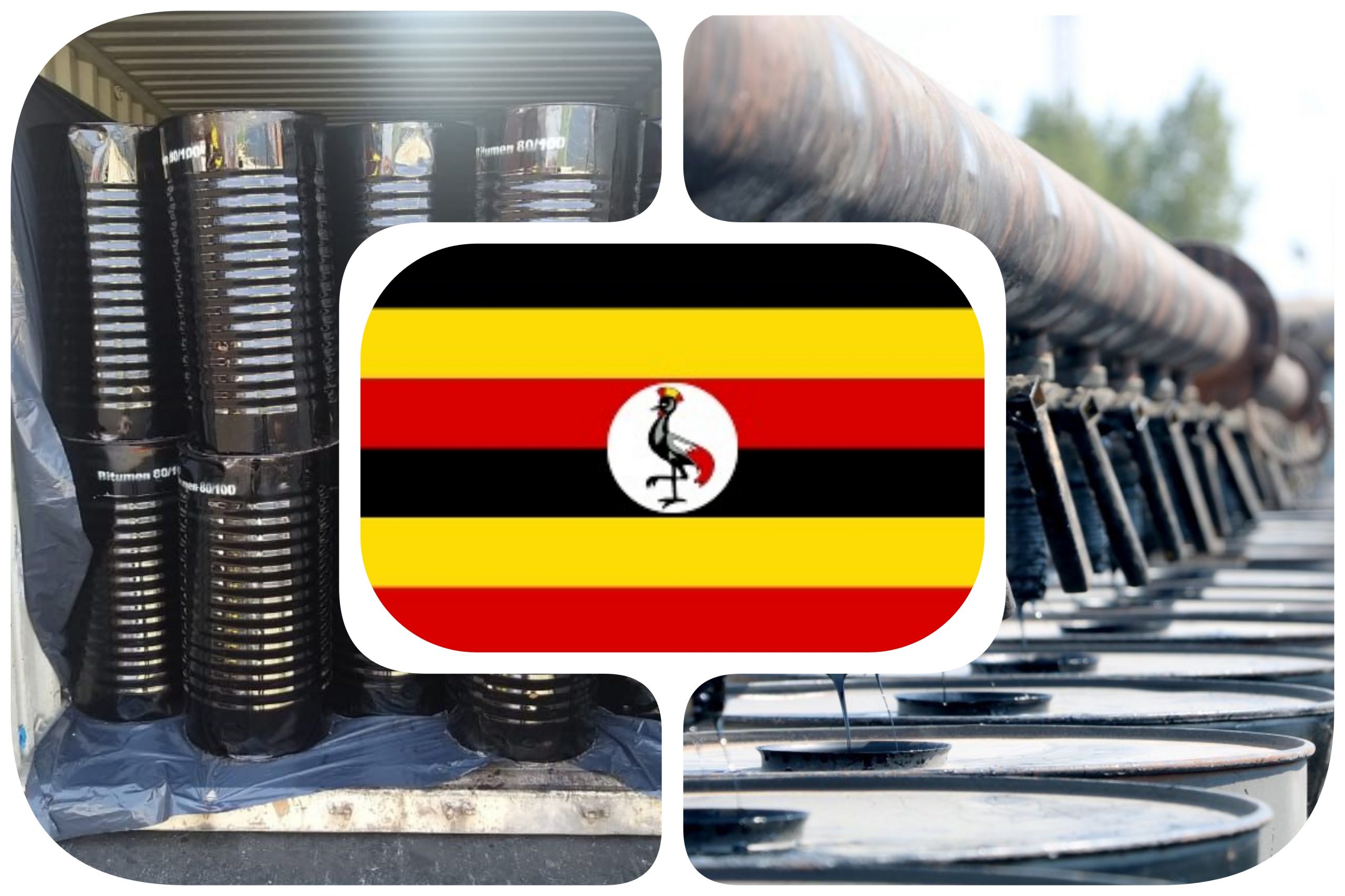
As a bitumen supplier in Uganda, Zumrut International Kimya delivers penetration grades 60/70, 80/100 and 40/50 to Kampala and across the country in drums, jumbo bags and bulk. Uganda is landlocked, which makes the inland corridor from Mombasa or Dar es Salaam a larger part of the delivered cost than the sea freight itself. Getting that routing right is worth more to your budget than shaving a few dollars off the product price.
Choosing a bitumen grade for Ugandan conditions
Penetration grade measures hardness at 25 °C: the lower the number, the harder the binder. As a bitumen supplier in Uganda we are asked constantly whether the rain changes the grade, and the honest answer is no — and the confusion costs money.
Grade is matched to temperature, not moisture. What rainfall and humidity affect is stripping: the loss of adhesion between binder and aggregate. That is an aggregate selection, mix design and anti-strip additive problem. Choosing a softer binder because a site is wet gives you rutting without solving the moisture issue.
Uganda’s temperature picture is narrower than most people assume. Sitting on the equator at 1,100 to 1,200 metres, Kampala and much of the country have a remarkably stable climate — consistently warm, with little seasonal or day-to-night variation. That altitude moderation is why Uganda does not need the hard grades that Sudan or northern Kenya do.
| Grade | Penetration | Character | Where it fits in Uganda |
|---|---|---|---|
| Bitumen 40/50 | 40–50 dmm | Hardest | Freight terminals, industrial hardstanding, the Malaba and Busia border truck parks, mining haul roads. Heavy slow axle loads rather than extreme heat |
| Bitumen 60/70 | 60–70 dmm | Standard paving grade | The default across Uganda — the Northern Corridor, Kampala–Entebbe, trunk and regional roads nationwide |
| Bitumen 80/100 | 80–100 dmm | Softest | Cold-mix patching, stockpile maintenance material, lightly trafficked district and community access roads |
Typical values. A batch certificate of analysis is issued before every shipment.
The practical rule
60/70 covers the large majority of Ugandan road work. Step down to 40/50 where heavy slow-moving loads concentrate — border truck stops, freight terminals, industrial yards. Use 80/100 for maintenance carried out cold, not for trunk pavement. If a supplier recommends 80/100 for your highway because Uganda is wet, ask them to explain the mechanism; there isn’t one.
Getting bitumen into a landlocked country
This is the part that separates a working bitumen supplier in Uganda from one quoting FOB and hoping for the best. Uganda has no coastline, so every tonne arrives by sea into a neighbouring country and then travels several hundred kilometres overland.
| Route | Corridor | Approximate inland distance | Notes |
|---|---|---|---|
| Mombasa, Kenya | Northern Corridor via Nairobi, Eldoret and Malaba | ~1,170 km to Kampala | The dominant route. Road and rail options; most bitumen moves by truck |
| Dar es Salaam, Tanzania | Central Corridor via Mwanza or Rusumo | ~1,450 km to Kampala | Longer but sometimes faster when Mombasa is congested; also serves western Uganda well |
Two consequences follow, and both affect what you should order.
Packing matters more here than almost anywhere. A thousand kilometres of road transport is hard on cargo. Sealed steel drums handle it; bagged product is more vulnerable to damage and moisture over that distance. The packing premium on drums is usually recovered in reduced losses.
Transit clearance is a separate process. Cargo moving through Kenya or Tanzania to Uganda travels under a regional transit regime with its own documentation and bonding requirements — not the same as clearing for domestic use in the port country. It must be arranged before the vessel arrives, not after.
Applications across Ugandan projects
These are the applications a bitumen supplier in Uganda is most often asked to cover, from national corridor contracts down to district road maintenance.
-
Northern Corridor and trunk roads
The Malaba–Kampala route and onward toward Rwanda, South Sudan and eastern DRC. Continuous heavy freight traffic.
-
Urban roads
Kampala, Entebbe, Jinja, Mbarara and Gulu — municipal streets and arterials, frequently rehabilitation rather than new build.
-
District and community access roads
The largest programme by length. Often surface dressing or cold-mix work carried out by crews without hot plant.
-
Airport pavements
Entebbe International and regional airstrips serving tourism and the oil sector.
-
Oil sector infrastructure
Access roads and hardstanding in the Albertine Graben around Hoima and Buliisa, plus pipeline corridor works.
-
Freight terminals and border facilities
Truck parks and container yards at Malaba, Busia and the inland container depots. Static and slow-moving heavy loads.
Cutback and emulsion for the wet season
Uganda has two rainy seasons — roughly March to May and September to November — which constrains when hot-mix work can be carried out. That makes cold-applied products more than a convenience here.
Cutback grades, MC-30 and MC-70 for prime coats and RC for surface dressing, cure by solvent evaporation and need a dry surface. Emulsions, particularly cationic CSS-1 and CRS-1, tolerate damp aggregate better because water is already the carrier. Neither bonds to a genuinely wet surface, but emulsion is considerably more forgiving of residual moisture — which extends the working window on district road programmes.
See our comparison of cutback bitumen vs bitumen emulsion for the full picture on which to specify.
Importing directly versus buying from a local trader
Uganda has no domestic bitumen production, so every tonne is imported. Working with an importing bitumen supplier in Uganda rather than a Kampala reseller changes three things worth weighing.
Traceability. You receive the batch certificate of analysis for the material actually loaded, not a generic specification sheet. If a pavement underperforms, you can trace the binder to a production batch.
Price structure. A resold cargo carries the trader’s margin on top of landed cost, and in a landlocked market that margin also absorbs the inland leg. On a large contract, controlling both the product and the corridor arrangement directly is where the real saving sits.
Lead time visibility. You see the production date, the vessel and the inland schedule rather than being told stock is on the way. With a 1,170 km inland haul, knowing where the cargo actually is matters.
The trade-off is volume. Direct import starts at 100 MT, so for smaller maintenance quantities a local trader remains the practical route.
Bitumen price in Uganda
Delivered price to Kampala is built from four moving parts, and the balance between them is different from a coastal market. Any bitumen supplier in Uganda quoting a flat number without naming these is quoting a number that will not hold.
Crude and vacuum bottom. Vacuum bottom is the feedstock and its price tracks crude with a lag. This is the largest single component and it sets the direction of the market.
Ocean freight to Mombasa. Rates from the Gulf and the Mediterranean into East African ports move independently of crude and swing with vessel availability and Red Sea routing.
Inland transport. This is the component that makes Uganda different. Over 1,100 km of road haulage from Mombasa is a substantial share of delivered cost, and it moves with fuel price, corridor congestion and border clearance times rather than with anything happening in the bitumen market.
Packing and grade. 60/70 is the benchmark and cheapest. 40/50 and 80/100 carry a modest premium. Drums cost more than bulk but survive the corridor better.
Indicative levels are published on our bitumen price page and updated weekly. A firm quote is issued against a specific quantity, delivery point and window.
Payment, inspection and documentation
Our standard terms as a bitumen supplier in Uganda are 50% by TT in advance, balance against a copy of the Bill of Lading. The advance secures production and loading; the balance falls due once the cargo is demonstrably on the water and documented.
A shipment travels with a commercial invoice, packing list, bill of lading, certificate of origin and the batch certificate of analysis. Uganda applies the East African Community common external tariff, and imported goods are generally subject to a pre-export verification of conformity programme administered through the Uganda National Bureau of Standards — meaning a certificate of conformity is normally needed before shipment rather than on arrival. Transit through Kenya or Tanzania adds its own documentation. Requirements change; confirm the current position with your clearing agent before the vessel loads.
SGS, Bureau Veritas or the surveyor named in your contract can attend loading for quality and quantity. A batch test report is issued by our QC before every shipment regardless.
Useful references: the Uganda National Bureau of Standards publishes current conformity requirements for imported goods, and the Uganda National Roads Authority issues the specifications most national road contracts are tendered against.
Packing and container loading
Packing choice drives both delivered cost and what survives the corridor. These are the options we ship as a bitumen supplier in Uganda.
| Packing | Unit | Per 20′ container | Notes |
|---|---|---|---|
| Steel drum | 180 kg | 80 drums = 14.4 MT | New sealed drums — the practical choice for the long inland haul from Mombasa |
| Steel drum | 200 kg | 80 drums = 16.0 MT | Lowest packing cost per tonne in drummed form |
| Jumbo bag | 300 kg | approx. 20 MT | Lower packing cost, requires forklift or crane at destination |
| Bulk bitutainer | 20–22 MT | 1 unit | Only where the receiving plant has heated tank storage |
Container figures are typical for standard 20′ dry containers and vary with the shipping line’s payload limit. Our minimum order of 100 MT is roughly seven containers of drummed product.
Frequently asked questions about bitumen supply in Uganda
The questions below come up in almost every enquiry we receive as a bitumen supplier in Uganda.
Which bitumen grade is right for road construction in Uganda?
60/70 for the large majority of trunk and regional road work. Uganda sits on the equator at over 1,100 metres, and that altitude moderates temperature enough that the harder grades used in the Sahel are not needed. Step down to 40/50 for freight terminals, border truck parks and industrial hardstanding. Use 80/100 for cold-mix patching and lightly trafficked district roads.
Does Uganda’s rainfall mean we should use a softer grade?
No. Penetration grade is matched to temperature, not moisture. What rain and humidity affect is stripping — loss of adhesion between binder and aggregate — which is solved through aggregate selection, mix design and anti-strip additives. Specifying a softer binder because a site is wet costs you rutting resistance without addressing the actual problem.
Should we route through Mombasa or Dar es Salaam?
Mombasa via the Northern Corridor is the dominant route at roughly 1,170 km to Kampala. Dar es Salaam via the Central Corridor is longer at around 1,450 km but can be faster when Mombasa is congested, and it suits western Uganda better. Send us the delivery point and quantity and we will price both.
How does transit clearance work for a landlocked destination?
Cargo moving through Kenya or Tanzania to Uganda travels under a regional transit regime with its own documentation and bonding requirements, separate from clearing for domestic use in the port country. It has to be arranged before the vessel arrives. A supplier who has not handled transit to a landlocked market before will discover this after your cargo has landed.
Which packing works best for delivery to Kampala?
Sealed steel drums. Over 1,100 km of road haulage is hard on cargo, and drums survive it considerably better than bagged product while needing no heated discharge facility at destination. Bulk bitutainers only make sense where the receiving plant has tank storage.
What is the minimum order quantity?
100 MT, which is roughly seven 20′ containers of drummed product or five bulk bitutainers. Mixed grades within one shipment are accepted provided each grade reaches one full container.
What are your payment terms?
50% by TT in advance with the balance settled against a copy of the Bill of Lading. The advance covers production and loading; the balance falls due once the cargo is documented and on the water.
Can we work during the rainy seasons?
Hot-mix work needs dry conditions and a dry base, which limits it during the March to May and September to November rains. Emulsion grades extend the window because water is already the carrier and they tolerate damp aggregate better than cutback does. Nothing bonds to a genuinely wet surface, but cationic emulsions are the most forgiving option.
Do you supply cutback bitumen and emulsion to Uganda?
Yes. MC, RC and SC cutback grades for prime coats and surface dressing, and anionic and cationic emulsions for tack coats and slurry seals. Both can be combined with penetration grades in the same shipment provided each product reaches one full container.
Specification
Bitumen 60/70
| Bitumen 60/70 | Test method | Unit | Specification |
|---|---|---|---|
| Specific gravity @ 25°C | ASTM D70 | Kg/cm3 | 1.01/1.06 |
| Penetration @ 25°C | ASTM D5 | mm/10 | 60/70 |
| Softening point °C | ASTM D36 | °C | 49/56 |
| Ductility @25 °C | ASTM D113 | cm | 100 min |
| Loss on heating(wt) % | ASTM D6 | wt % | 0.2 max |
| Drop in penetration after heating % | ASTM D5-D6 | % | 20 max |
| Flashpoint °C | ASTM D92 | °C | 232 min |
| Solubility in Trichloroethylene | ASTM D2042 | wt % | 99 min |
| Spot test | A.A.S.H.O.T102 | Negative |
Bitumen 80/100
| Bitumen 80/100 | Test method | Unit | Specification |
|---|---|---|---|
| Specific gravity @ 25°C | ASTM D70 | Kg/cm3 | 1.01/1.06 |
| Penetration @ 25°C | ASTM D5 | mm/10 | 80/100 |
| Softening point °C | ASTM D36 | °C | 42/50 |
| Ductility @25 °C | ASTM D113 | cm | 100 min |
| Loss on heating(wt) % | ASTM D6 | wt % | 0.2 max |
| Drop in penetration after heating % | ASTM D5-D6 | % | 20 max |
| Flashpoint °C | ASTM D92 | °C | 250 min |
| Solubility in CS2(wt) % | ASTM D4 | wt % | 99.5 min |
| Spot test | A.A.S.H.O.T102 | Negative |
Bitumen 40/50
| Bitumen 40/50 | Test method | Unit | Specification |
|---|---|---|---|
| Specific gravity @ 25°c | ASTM D70 | Kg/cm3 | 1.01/1.06 |
| Penetration @ 25°c | ASTM D5 | mm/10 | 40/50 |
| Softening point °c | ASTM D36 | °C | 52/60 |
| Ductility @25 °c | ASTM D113 | cm | 100 min |
| Loss on heating(wt) % | ASTM D6 | wt % | 0.2 max |
| Drop in penetration after heating % | ASTM D5-D6 | % | 20 max |
| Flash point °c | ASTM D92 | °C | 250 min |
| Solubility is CS2(wt) % | ASTM D4 | wt % | 99.5 min |
| Spot test | A.A.S.H.O.T102 | _____ | Negative |
Bitumen supply in other markets
Alongside our work as a bitumen supplier in Uganda, we ship penetration, oxidized, cutback and emulsion grades across Africa, Southeast Asia, Central Asia and South America. See the global bitumen supply guide for country-level detail, or compare grades on our penetration grade bitumen page.
Order bitumen for Uganda
Send us the grade, quantity, packing and delivery point — not just the port — and we will come back with a firm price, a production schedule and the documentation list for transit and clearance. If you have a specification from UNRA or a consulting engineer and are not sure which grade meets it, send the specification instead.
Dubai +971 4 566 4998 · Ankara +90 507 246 9520
