
Bitumen Supplier in Benin — Penetration, VG and Oxidized Grades via Cotonou
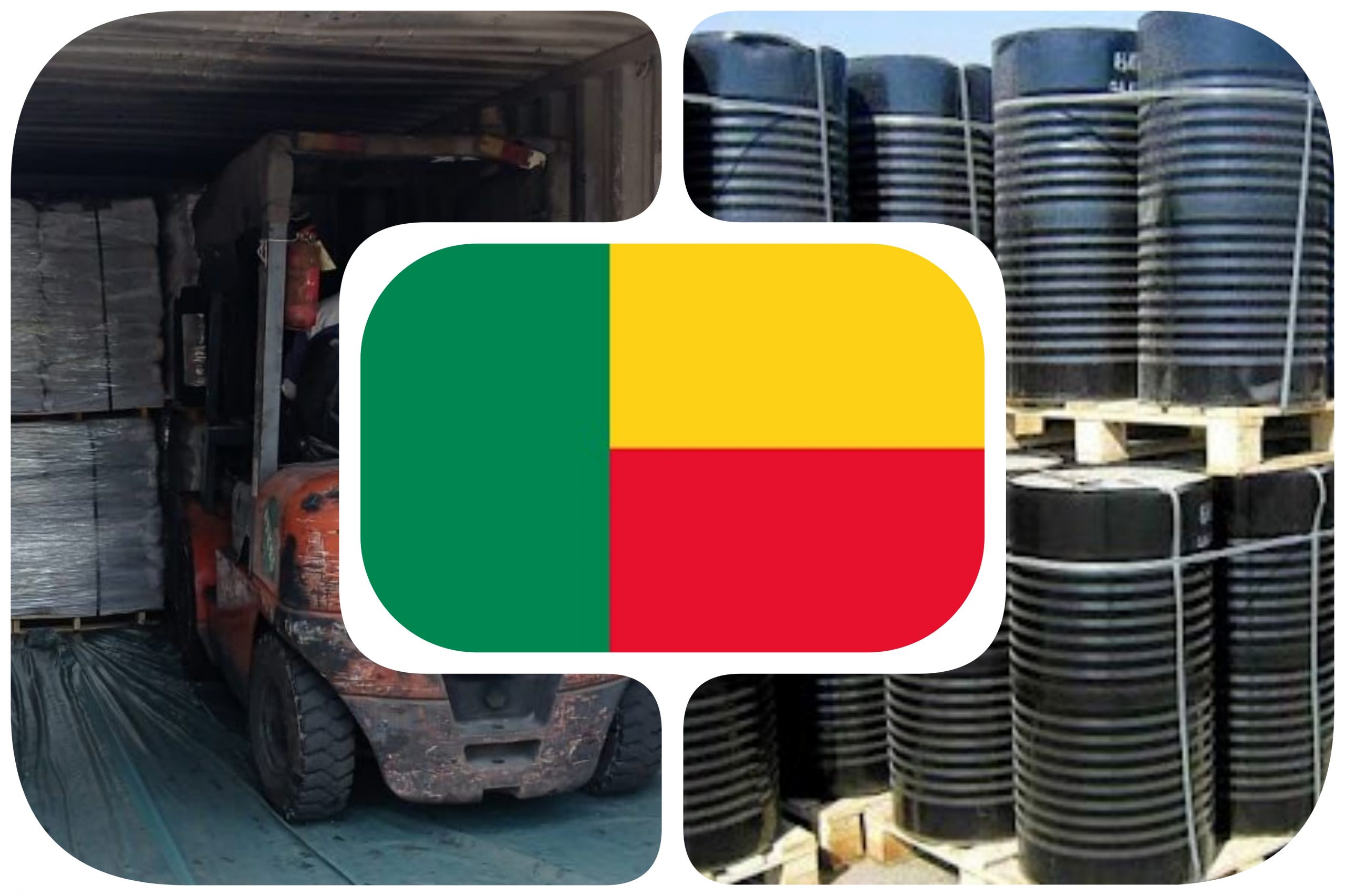
As a bitumen supplier in Benin, Zumrut International Kimya delivers penetration grades, viscosity grades and oxidized bitumen into the Port of Cotonou in drums, jumbo bags and bulk. Cotonou is not just Benin’s port — it is the maritime gateway for Niger, and a significant one for Burkina Faso and northern Nigeria. That transit role shapes how binder moves through this country and is worth understanding before you fix a delivery route.
Choosing a bitumen grade for Beninese conditions
Penetration grade measures hardness at 25 °C: the lower the number, the harder the binder. As a bitumen supplier in Benin, the first thing we establish is where in the country the road sits, because Benin spans two genuinely different climate zones over a relatively short distance.
The south — Cotonou, Porto-Novo, Ouidah, Abomey-Calavi — is equatorial: consistently hot, humid, two rainy seasons, and a narrow day-to-night temperature range. The north, from Parakou up through Kandi to the Niger border, is Sudanian savanna: hotter peak temperatures, a single rainy season, and a much wider diurnal swing, with the Harmattan bringing dry dusty conditions between December and February.
Those are different binder problems. The south asks for resistance to sustained heat and moisture. The north asks for resistance to peak heat plus a wide daily temperature cycle.
| Grade | Penetration | Character | Where it fits in Benin |
|---|---|---|---|
| Bitumen 40/50 | 40–50 dmm | Hardest | Northern savanna zone, Cotonou port aprons, heavy transit corridors carrying loaded trucks to Niger and Burkina Faso |
| Bitumen 60/70 | 60–70 dmm | Standard paving grade | The default across most of the country — southern urban roads, regional links, general road construction |
| Bitumen 80/100 | 80–100 dmm | Softest | Cold-mix patching, stockpile maintenance material, lightly trafficked rural tracks. Not a trunk road grade in this climate |
Typical values. A batch certificate of analysis is issued before every shipment.
The practical rule
Start with the hottest pavement temperature the road will see, then check the traffic. Heavy slow-moving loads plus heat — the RNIE1 corridor north from Cotonou, port approaches, transit routes to the Sahel — point to 40/50. Ordinary regional and urban work sits comfortably on 60/70. Reserve 80/100 for maintenance carried out cold, where workability matters more than stiffness.
Viscosity grades: VG10 and VG30
Viscosity grading is a different system from penetration grading, not a different product, and it is a distinction any bitumen supplier in Benin should be able to explain rather than gloss over. Where penetration grade measures how far a needle sinks into the binder at 25 °C, viscosity grade measures flow resistance at 60 °C — closer to actual pavement service temperature. The system is standard in India under IS 73 and is specified on projects across West Africa, particularly where the contractor or funding body works to Indian specifications.
| Grade | Viscosity @60 °C | Rough equivalent | Use in Benin |
|---|---|---|---|
| VG10 | 800–1200 poise | Near 80/100 | Spray applications — surface dressing, prime and tack coats, low-traffic rural roads |
| VG30 | 2400–3600 poise | Near 60/70 | Heavy-duty paving — national highways, expressways, high-traffic corridors and port access roads |
Equivalences are approximate. A binder meeting 60/70 will not automatically pass VG30, and vice versa — the tests measure different properties. If your tender names a VG grade, ask for material certified against IS 73 rather than a penetration grade with a note attached.
Oxidized bitumen for roofing and waterproofing
Southern Benin’s humidity and rainfall make moisture protection a structural requirement in building work, not a finishing detail, which is why a bitumen supplier in Benin ships as much oxidized product here as paving binder. Oxidized (blown) bitumen is produced by forcing air through hot penetration bitumen, which raises the softening point and lowers penetration. The result holds its shape on a hot roof instead of flowing, and resists standing water rather than absorbing it.
| Grade | Softening point | Penetration | Use in Benin |
|---|---|---|---|
| Oxidized 85/25 | 80–90 °C | 20–30 dmm | The most widely traded grade — roofing felt, torch-on membranes, foundation damp-proofing |
| Oxidized 90/40 | 85–95 °C | 35–45 dmm | Higher heat rating with retained flexibility — exposed roofing and sealing where the membrane must accommodate movement |
| Oxidized 115/15 | 110–120 °C | 10–20 dmm | Hardest common grade — steel pipe coating, industrial membranes, heavy-duty protective sealing |
Full range and specifications on our oxidized bitumen page.
Cotonou and the Sahel transit corridors
This is where Benin differs from most West African markets, and where a bitumen supplier in Benin should be asking about the final site rather than the discharge port.
The Port of Cotonou handles a large share of landlocked Niger’s seaborne imports, and moves meaningful volumes toward Burkina Faso and northern Nigeria. The RNIE2 corridor runs north from Cotonou through Bohicon and Parakou to Malanville on the Niger border, and onward to Niamey. If your project is in Niger or the Sahel, discharging at Cotonou is frequently faster and cheaper than routing through Lomé, Tema or Lagos.
Two practical consequences. First, the sea leg and documentation for a Niger-bound cargo are identical to a Benin-bound one — only the inland arrangement and transit paperwork change. Second, that corridor carries heavy loaded trucks continuously, which is exactly the traffic pattern that argues for a harder binder on the road itself.
Applications across Beninese projects
These are the applications a bitumen supplier in Benin is most often asked to cover, from national road contracts down to district maintenance work.
-
National road construction
The RNIE network linking Cotonou to Parakou, Malanville and the borders. High traffic, sustained heat, and heavy transit loads.
-
Urban roads
Cotonou, Porto-Novo, Abomey-Calavi and Parakou — municipal streets and arterials, often rehabilitated rather than newly built.
-
Surface dressing and sealing
VG10 and cutback grades on rural and secondary roads, where a sprayed seal is far cheaper per kilometre than an asphalt overlay.
-
Port and industrial hardstanding
Cotonou port aprons, container yards and industrial zones. Static and slow-moving loads under full sun.
-
Roof waterproofing
Membranes and coatings across the southern humid belt, where roof performance determines building service life.
-
Pipe coating and industrial sealing
Anti-corrosion coating on buried steel, using hard oxidized grades applied hot with a felt or glass fibre wrap.
Importing directly versus buying from a local trader
Benin has no domestic bitumen production, so every tonne used or transited through the country is imported. Working with an importing bitumen supplier in Benin rather than a local reseller changes three things worth weighing.
Traceability. You receive the batch certificate of analysis for the material actually loaded, not a generic specification sheet. If a pavement underperforms, you can trace the binder to a production batch.
Price structure. A resold cargo carries the trader’s margin on top of landed cost. On 100 MT that margin is modest; on a multi-thousand-tonne contract it becomes a line item worth negotiating directly.
Lead time visibility. You see the production and sailing schedule rather than being told stock is on the way. For a contractor with a fixed mobilisation date, knowing the vessel and ETA is worth more than a marginally lower quote.
The trade-off is volume. Direct import starts at 100 MT, so for smaller maintenance quantities a local trader remains the practical route.
Bitumen price in Benin
Delivered price into Cotonou is built from four moving parts. Knowing which one is moving tells you whether to fix a price now or wait, and any bitumen supplier in Benin quoting a flat number without naming these is quoting a number that will not hold.
Crude and vacuum bottom. Vacuum bottom is the feedstock and its price tracks crude with a lag. This is the largest single component and it sets the direction of the market.
Ocean freight. Rates from the Gulf and the Mediterranean into West African ports move independently of crude and swing with vessel availability and Red Sea routing. West Africa is a long haul from both our loading origins, so freight is a larger share of delivered cost here than in East African markets.
Packing. Drums cost more per tonne than bulk but need no receiving infrastructure and survive inland haulage better. For cargo transiting to Niger or Burkina Faso, that durability usually outweighs the packing premium.
Grade. 60/70 is the benchmark and the cheapest, because it is produced in the largest volume. 40/50, 80/100 and the VG grades carry a modest premium. Oxidized grades cost more, reflecting the additional processing.
Indicative levels are published on our bitumen price page and updated weekly. A firm quote is issued against a specific quantity, discharge port and delivery window.
Payment, inspection and documentation
Our standard terms as a bitumen supplier in Benin are 30% by TT in advance, balance against a copy of the Bill of Lading. The advance secures production and loading; the balance falls due once the cargo is demonstrably on the water and documented. For repeat contracts we also work against an irrevocable LC at sight.
A shipment to Benin normally travels with a commercial invoice, packing list, bill of lading, certificate of origin and the batch certificate of analysis. Benin applies the ECOWAS and WAEMU customs framework. Cargo in transit to Niger or Burkina Faso moves under a separate transit regime with its own documentation and bonding requirements — that is a different process from clearing for domestic use, and it needs to be arranged before arrival rather than after. Confirm the current position with your transitaire before the vessel loads.
SGS, Bureau Veritas or the surveyor named in your contract can attend loading for quality and quantity. A batch test report is issued by our QC before every shipment regardless.
Packing and container loading
Packing choice drives both delivered cost and what you need at destination, and for a bitumen supplier in Benin it is complicated by the transit trade. These are the options we ship.
| Packing | Unit | Per 20′ container | Notes |
|---|---|---|---|
| Steel drum | 180 kg | 80 drums = 14.4 MT | New sealed drums; the practical choice for transit cargo moving inland to the Sahel |
| Steel drum | 200 kg | 80 drums = 16.0 MT | Lowest packing cost per tonne in drummed form |
| Kraft bag | 25 kg | approx. 20 MT palletised | Oxidized grades only. Store under cover in the humid southern zone |
| Jumbo bag | 300 kg | approx. 20 MT | Lower packing cost, requires forklift or crane at destination |
| Bulk bitutainer | 20–22 MT | 1 unit | Only where the receiving plant has heated tank storage |
Container figures are typical for standard 20′ dry containers and vary with the shipping line’s payload limit. Our minimum order of 100 MT is roughly seven containers of drummed product.
Frequently asked questions about bitumen supply in Benin
The questions below come up in almost every enquiry we receive as a bitumen supplier in Benin.
Which bitumen grade is right for road construction in Benin?
60/70 for most work across the country. Step down to 40/50 in the northern savanna zone, on the Cotonou port approaches, and on the transit corridors carrying loaded trucks to Niger and Burkina Faso, where heat and heavy slow traffic combine. Use 80/100 only for cold-mix patching and lightly trafficked rural tracks — it is too soft for trunk pavement in this climate.
What is the difference between VG30 and penetration grade 60/70?
They are different grading systems, not different products. Penetration 60/70 measures needle penetration at 25 °C; VG30 measures absolute viscosity at 60 °C under IS 73, closer to real service temperature. They are roughly comparable in consistency, but a binder meeting one does not automatically meet the other. If your tender names a VG grade, ask for material certified against IS 73 rather than a penetration grade with a note attached.
Can you deliver to Niger or Burkina Faso through Cotonou?
Yes. The Port of Cotonou handles a large share of Niger’s seaborne imports and moves volumes toward Burkina Faso and northern Nigeria via the RNIE2 corridor through Parakou to Malanville. The sea leg and documentation are the same as for a Benin-bound cargo; what changes is the inland arrangement and the transit customs regime, which must be arranged before arrival.
Does the humidity in southern Benin change which grade we should use?
Not for paving. Penetration grade is matched to temperature, not moisture. What humidity and rain affect is stripping — the loss of adhesion between binder and aggregate — which is addressed through aggregate selection, mix design and anti-strip additives. Where the climate does change the specification is waterproofing: roofing and foundation work in the southern belt needs oxidized grades, not paving binder.
Which oxidized grade should we use for roofing in Benin?
85/25 for most roofing felt and membrane work. Move to 90/40 where the membrane is fully exposed to sun and must also accommodate movement. Use 115/15 for pipe coating and heavy-duty industrial sealing rather than roofing — it is considerably harder and less forgiving to apply.
What is the minimum order quantity?
100 MT, which is roughly seven 20′ containers of drummed product or five bulk bitutainers. Mixed grades within one shipment are accepted provided each grade reaches one full container.
What are your payment terms?
30% by TT in advance with the balance settled against a copy of the Bill of Lading. The advance covers production and loading; the balance falls due once the cargo is documented and on the water. Irrevocable LC at sight is available for repeat contracts.
How should we choose a bitumen supplier in Benin?
Ask for a batch certificate of analysis rather than a generic specification sheet. Ask which loading port the cargo leaves from and on which vessel. Ask whether third-party inspection at loading is available. And if your cargo is transiting to the Sahel, ask specifically whether the supplier has handled transit clearance at Cotonou before — it is a different process from domestic clearance and a supplier who has not done it will discover that after your cargo has arrived.
Bitumen supply in other markets
Alongside our work as a bitumen supplier in Benin, we ship penetration, oxidized, cutback and emulsion grades across Africa, Southeast Asia, Central Asia and South America. See the global bitumen supply guide for country-level detail, or compare grades on our penetration grade bitumen page.
Order bitumen for Benin
Send us the grade, quantity, packing and final destination — not just the port — and we will come back with a firm price, a production schedule and the documentation list for clearance or transit. If you have a specification from a consulting engineer or a tender document and are not sure which grade meets it, send the specification instead — a bitumen supplier in Benin should be able to read a tender specification and confirm the grade before you commit to a price.
Dubai +971 4 566 4998 · Ankara +90 507 246 9520 · Isfahan
